Brush Clearing Methods, Results, and When to Call a Pro
Learn brush clearing methods, what results to expect, maintenance needs, and when hiring a professional is the smarter move for your acreage.
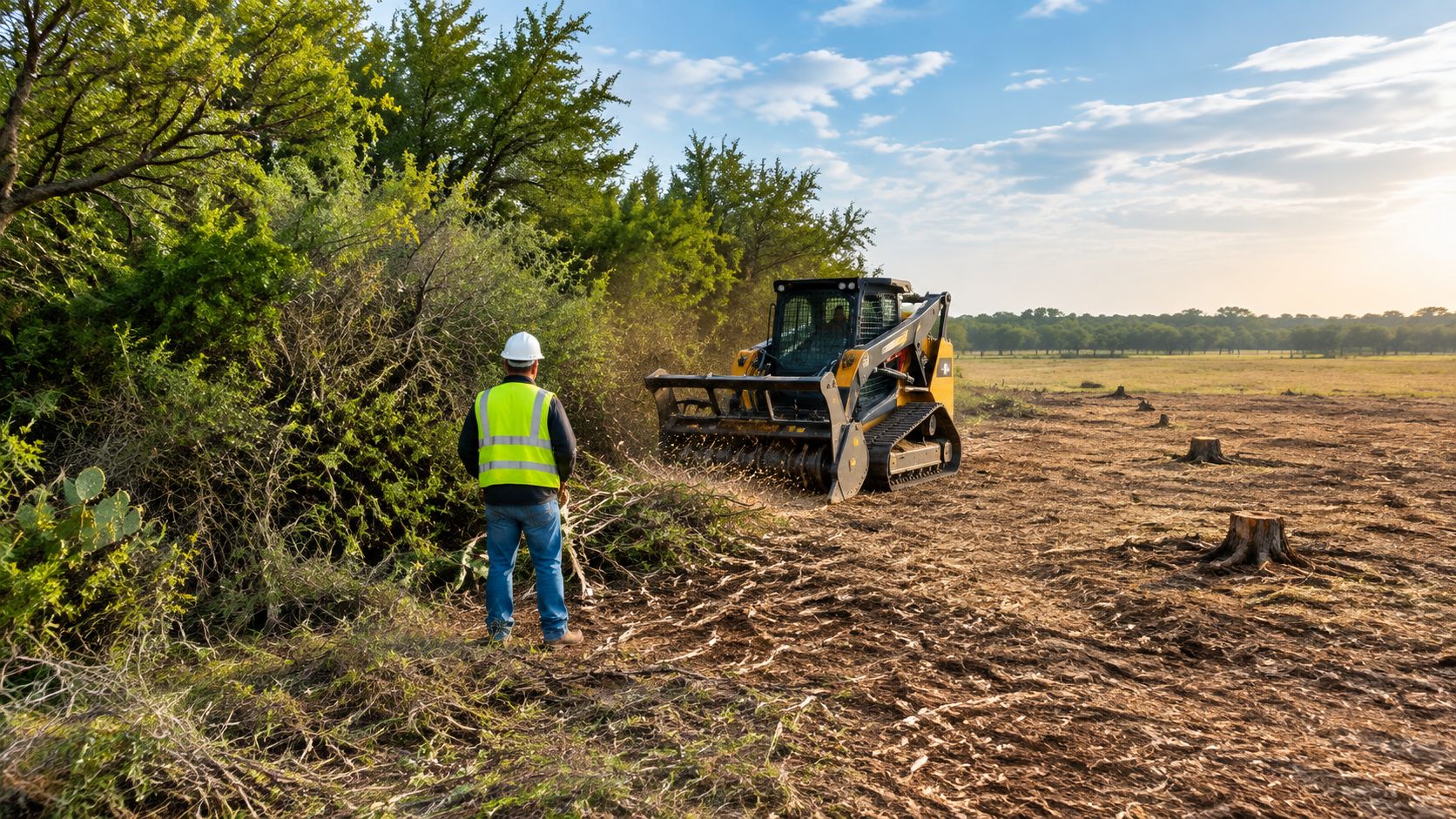
You can usually spot the problem before you ever grab a saw. The driveway narrows, the fence line vanishes into cedar, the pasture turns into a patchwork of saplings, and the part of the place you meant to use keeps shrinking every season. At that point, brush clearing stops being a cosmetic job and starts becoming a land-use decision.
The tricky part is that the right answer is rarely “clear everything.” On Hill Country acreage, what works depends on whether you want better access, a safer homesite, a cleaner fence line, reopened pasture, or just a property that feels usable again. A good clearing plan matches the method to the goal, the slope, the soil, and the kind of brush you're fighting.
Table of Contents
- The Moment Most Landowners Realize They Need Brush Clearing
- What Brush Clearing Means on a Property
- Comparing the Main Brush Clearing Methods
- Matching the Method to Your Vegetation and Terrain
- What a Well-Planned Brush Clearing Project Looks Like
- Why More Clearing Is Not Always Better
- Maintenance, Regrowth, and the Cost of Doing Nothing
- When It Makes Sense to Hire a Brush Clearing Professional
The Moment Most Landowners Realize They Need Brush Clearing
The first real clue is usually a walk that feels shorter than it used to. You step off the truck planning to look around, and now you're pushing through cedar, ducking low limbs, and guessing where the fence line runs because the vegetation took it over. What used to be a trail becomes a tunnel, and what used to be open ground starts feeling like woods you didn't ask for.
That's the point where most landowners realize the brush isn't just present, it's deciding how the land gets used. Deer bed down somewhere quieter, vehicles stop reaching the back fence, and the pasture starts producing less useful ground than it should. On bigger properties, the problem often starts as inconvenience and ends as lost function.
What usually pushes the decision
- Hidden boundaries: Fencelines disappear fast once saplings and thorny regrowth move in.
- Lost access: Trails, gates, and crossings become harder to reach and maintain.
- Pasture pressure: Volunteer trees and woody stems begin crowding out open ground.
- View loss: The property feels smaller because sightlines are blocked.
- Safety concerns: Around homes, barns, and drives, brush starts creating an access and fire-management issue.
A lot of landowners wait until the property looks “bad enough” before acting. In practice, the better trigger is usability. If you can't move through the land, inspect it, fence it, or manage it without fighting vegetation, the brush has already won that round.
Practical rule: If brush changes how you move, park, fence, or graze the property, it's no longer background growth. It's part of the operating problem.
The rest comes down to choosing the right response. That means knowing what brush clearing includes, what each method does to the ground, and which trade-offs matter more than the price of the machine.
What Brush Clearing Means on a Property
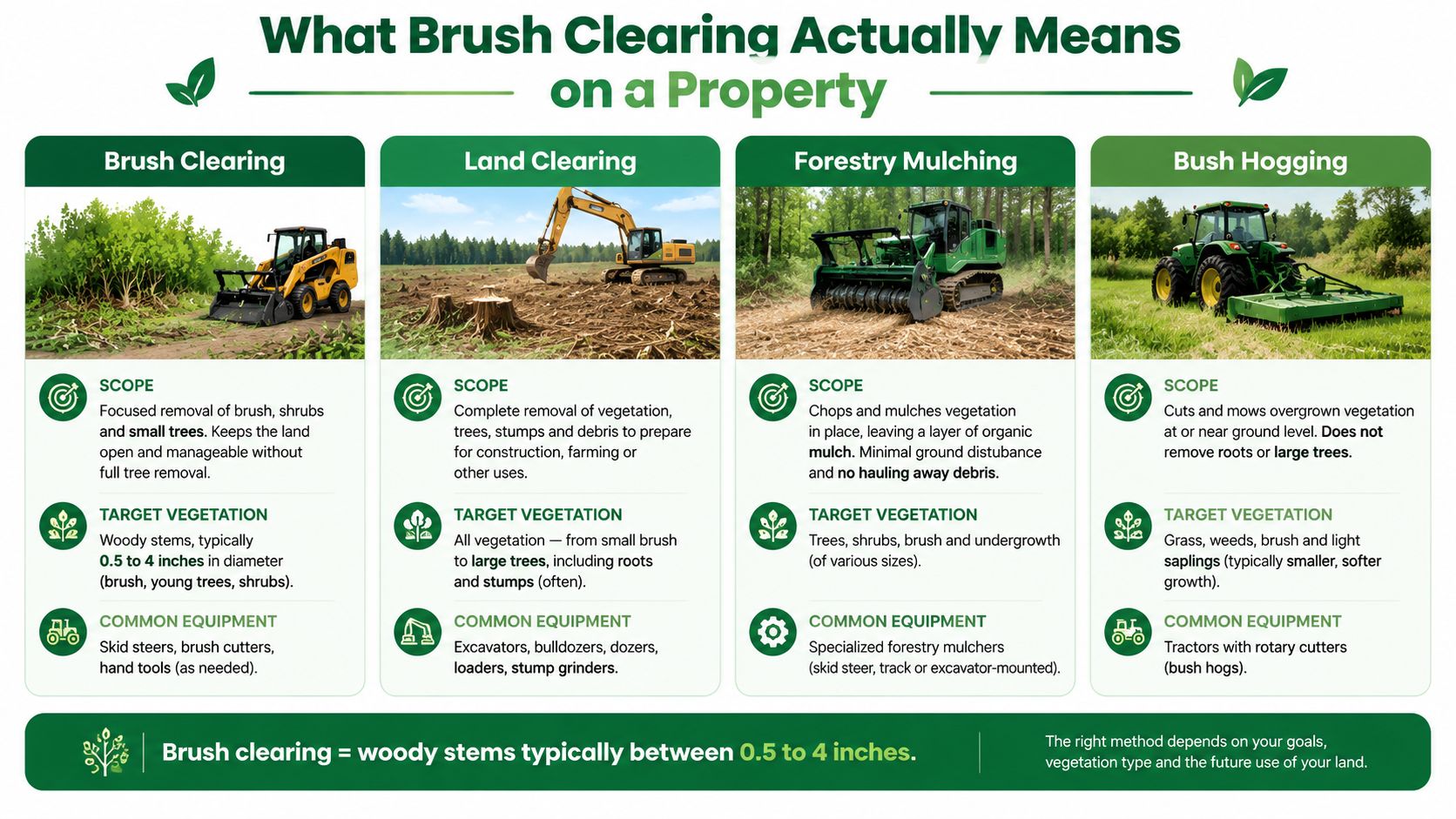
Brush clearing sits between mowing and full land clearing. It targets woody stems, usually sapling to small-tree size, along with thick undergrowth that regular mowing will not touch. The goal is to reopen use without stripping the property down to raw soil or removing every tree that gives the place character.
A full land clearing job is a different kind of project. It is used for construction pads, major pasture conversion, or any site that needs bare, workable soil. Routine mowing handles grass and herbaceous growth, but it barely slows woody regrowth. A mower can make a brushy area look tidy for a while, yet the rooted problem stays in place.
Forestry mulching belongs in a different category altogether. A mulcher cuts and shreds standing vegetation in place, then leaves processed material on the surface as cover. That finish matters because some landowners want less hauling and less disturbance, while others want the ground scraped cleaner for access or construction. Soil disturbance, regrowth, wildfire strategy, and the cost of doing nothing all show up in that choice.
The fastest way to sort the project
Ask one question. What do you want left behind?
- Native trees and soil cover: selective brush clearing or forestry mulching.
- Raw soil for building or grading: full land clearing.
- Short grass with light regrowth knocked back: mowing or bush hogging.
- A cleaner surface with less hauling: mulching.
- A more open finish with root removal: grubbing or heavier clearing.
That question usually tells you whether the job is a light maintenance pass or a serious reclamation project. It also keeps you from paying for the wrong finish, which happens often on acreage where the landowner only wanted access, but the crew treated it like a subdivision pad.
Brush clearing works when the property ends up more usable without losing more than necessary. If the job keeps the right trees, restores access, and leaves the right amount of ground cover, it is in the right category.
Comparing the Main Brush Clearing Methods
Different methods solve different problems, and a lot of projects go sideways here. People start with the machine they know, not the finish they need. A hand crew, a skid steer, a mulcher, and an excavator can all “clear brush,” but they don't leave the same property behind.
| Method | Best For | Terrain Limits | Finished Result | Main Trade-Off |
|---|---|---|---|---|
| Hand cutting and piling | Small infestations, tight areas, selective work | Labor-heavy on larger acreage | Clean cuts with brush stacked or hauled | Slow, physical, and not practical for widespread regrowth |
| Heavy brush mowing | Grass, light saplings, recurring upkeep | Struggles in dense woody growth | Knocked-down top growth, rough surface | Fast, but weak on roots and resprouting brush |
| Skid steer or track loader with grapple or bucket | Medium brush, pile work, access lanes | Needs workable ground and room to maneuver | Opened lanes and gathered debris | Can disturb soil if it's run too hard or too wet |
| Excavator clearing | Stumps, root mass, stubborn woody removals | Slower in open cleanup, needs room | Deeper removal and a rougher finish | More ground disturbance, more finish work afterward |
| Forestry mulching | One-pass cut and shred, selective opening | Less suited to soft, wet, or highly sensitive ground | Layered mulch cover with retained surface material | Great for access and cover, less effective when total root removal is the goal |
| Prescribed fire | Landscape-scale fuel management where allowed | Restricted by law, weather, and site conditions | Reduced surface fuels across broader areas | Requires planning, permits, and very specific conditions |
If you want a fuller breakdown of why mulching is chosen over scraping on many properties, this discussion on mulch-first clearing is worth reading.
The machine matters, but the finish matters more. A mulcher can leave the site easier to walk and less exposed, while heavier excavation may be the right answer where roots have to go. A mower is useful when regrowth is the main issue, but it won't rescue a property that's already choking on woody stems.
Contractor's note: The best method is the one that solves the actual land problem without creating a second job for erosion, cleanup, or regrowth.
Matching the Method to Your Vegetation and Terrain
The right method starts with the plant mix, then the ground under it. Cedar and yaupon often respond well to forestry mulching because it opens the property without stripping every bit of cover. Mesquite calls for more caution, since a top cut alone usually leaves you dealing with regrowth unless the stump is treated or the root system is addressed.
Reading the plant before choosing the tool
A stand of volunteer trees mixed with prickly pear usually needs more than one pass. One pass opens the area, then a follow-up treatment handles the problem plants that remain or come back. It takes more planning, but it avoids the common mistake of making the site look finished while the regrowth cycle keeps running.
Terrain shifts the choice just as much as species do. Tracked equipment starts to make more sense on serious slopes, because wheeled machines lose traction and leave rougher ground behind. On rocky draws and creek banks, hand crews can be the safer answer when the site is too uneven or too fragile for heavier passes.
Soil type matters too. Shallow limestone ground does not forgive repeated heavy traffic. If you rut it, you are not just leaving a track, you are creating a drainage problem that can worsen every time the property gets wet.
- Dominant species: cedar, yaupon, mesquite, volunteer trees, or mixed brush.
- Slope: flat, moderate, or steep enough to change equipment choice.
- Ground conditions: rock, shallow soil, drainage paths, and wet spots.
- Finish goal: access, pasture, views, defensible space, or prep for construction.
If you want a straightforward example of a brush-clearing service built around that kind of property-by-property decision making, Fieldmark's brush cutting service shows the same use-first logic in practice.
The best choice is the one that solves the main land problem without creating a second one. If the property is mostly brush but the soil is fragile, protect the soil. If the main issue is resprouting mesquite, a quick cut will not hold for long. If the slope is the primary hazard, let the terrain drive the equipment choice before anything else.
What a Well-Planned Brush Clearing Project Looks Like
A good project starts before a machine moves. The first walk should pin down what the landowner wants, because “clear it” can mean pasture reclamation, fence-line access, view opening, defensible space, or build prep. Each of those goals changes what gets cut, what stays, and how finished the site needs to look.
The mark-up matters just as much as the cutting. Trees to keep, drainages to avoid, fences to protect, and utility easements to respect should be identified first. If that part gets rushed, the cleanup stage turns into repair work.
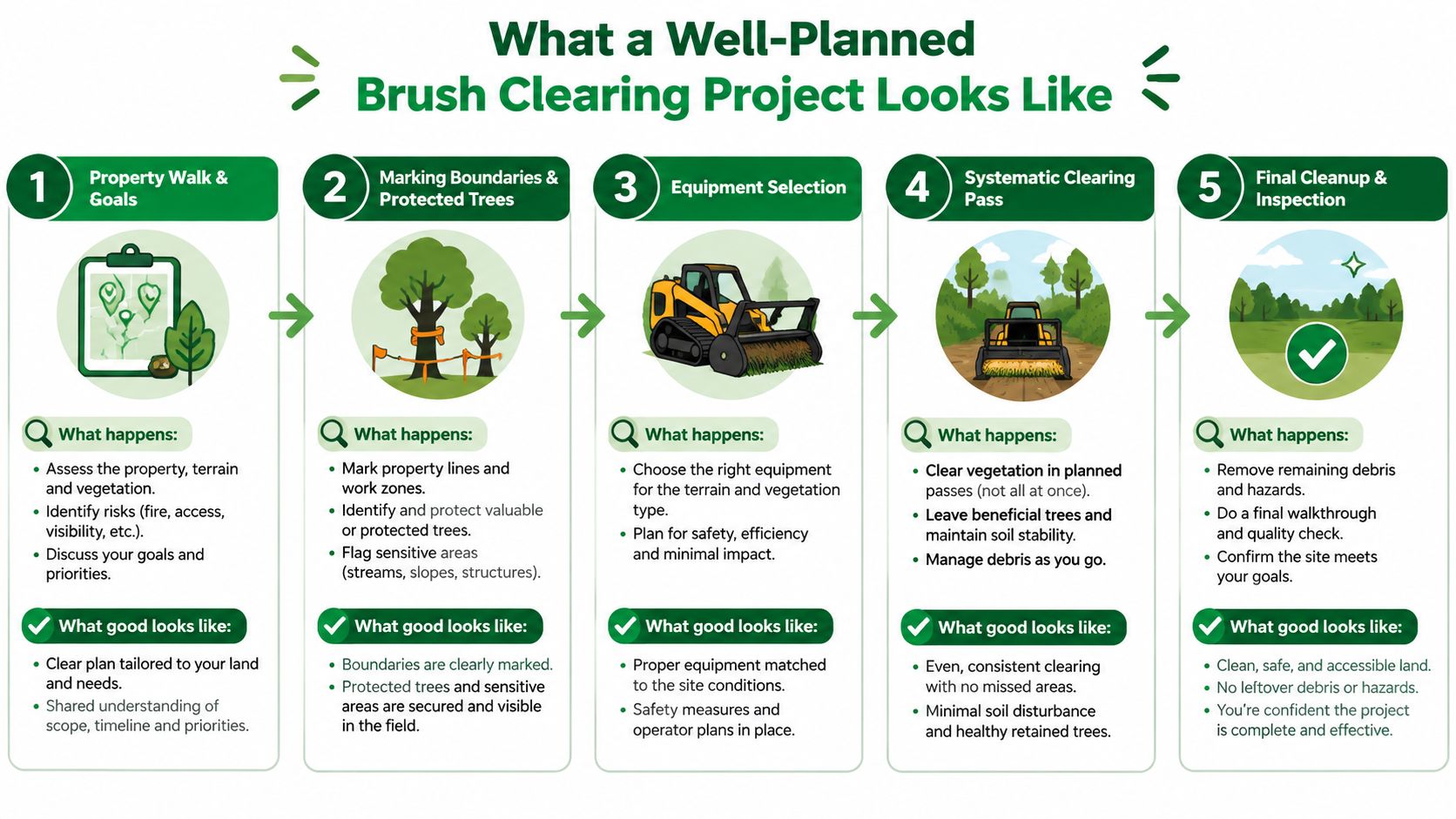
A typical professional sequence starts with a heavier pass to knock down tall material, then a finer pass to get the brush lower and more usable. Where resprouting species are involved, follow-up treatment matters more than making the first pass look dramatic. Final cleanup is where the job either earns its keep or leaves the landowner with a pile of problems.
What “done” should look like
- Pasture reclamation: open lanes, reduced woody pressure, and a finish that can be maintained.
- Fence-line clearing: visible boundary, room for inspection, and no hidden tangle around posts.
- Wildfire defensible space: targeted fuel reduction around structures and access routes.
- Build prep: cleared footprint, protected edges, and a finish consistent with the next trade.
- View opening: selective removal without stripping the character of the property.
Paperwork can stop work faster than bad weather. Burn restrictions, herbicide applicator rules, HOA restrictions, and easement terms all need to be checked before mobilization. A clean scope saves money because it prevents the crew from guessing what “finished” means after the equipment is already on site.
Why More Clearing Is Not Always Better
A bare property is not automatically a safer property. In fire-adapted places, wholesale removal can create a uniform fuel bed, especially when the result is short grass or exposed ground across the whole site. Selective thinning often does more useful work because it breaks fuel continuity while leaving the property with structure.
That same logic applies to wildlife. Deer, turkey, songbirds, and pollinators all use brush edges and cover differently, and a clean sweep erases that habitat quickly. A property can be more usable without becoming ecologically simpler than it needs to be.
The soil argument is even more direct. Clearing every living root on a slope invites erosion, and heavy disturbance over shallow limestone can leave a finish that's harder to recover than the original brush. That's why mosaic clearing, with strips, clumps, and shelter belts, often makes more sense than a uniform cut line.
Where selective work tends to win
- Around structures: reduce fuel where it threatens buildings and access.
- Along edges: keep some cover where habitat and wind protection still matter.
- On fragile slopes: avoid unnecessary stripping that leads to runoff.
- Under good tree canopy: thin the understory instead of bulldozing the whole site.
The best finish is the one that matches the landowner's use. On a lot of Hill Country acreage, that means opening the ground enough to move, fence, inspect, and manage it, while keeping the trees and cover that still serve a purpose.
Maintenance, Regrowth, and the Cost of Doing Nothing
Brush clearing is the start of management, not the end of it. A first follow-up visit after the work should catch missed plants, loose debris, damaged fences, and bare spots that might need erosion control. After that, the site needs regular eyes on it, especially after storms and through the growing season.
Regrowth is normal. Cedar, yaupon, mesquite, and volunteer trees can come back from roots, seed, or root sprouts, so no method should be treated like a permanent cure. Improved pasture often needs recurring mowing and periodic woody control, while around homes and evacuation routes the job is more about keeping dead material from piling up before peak fire weather.
For recurring upkeep and property care, Fieldmark's property maintenance service is a good example of how a landowner can keep the first clearing from turning into a repeat crisis.
The real cost of waiting
- Access shrinks: routes get narrower and harder to reopen.
- Edges decay: fence lines, trails, and gates get more expensive to reach.
- Work gets harder: mature brush takes more equipment and more time.
- Cleanup gets messier: debris and regrowth stack up together.
- Planning gets reactive: you end up solving emergencies instead of scheduling maintenance.
A decent maintenance rhythm depends on species removed, rainfall, soil disturbance, and how the land is used. The important part is tracking the site after the first treatment so future work doesn't turn into surprise damage. A little follow-up costs less than re-clearing an area that should have stayed open.
When It Makes Sense to Hire a Brush Clearing Professional
A professional crew makes sense when the site itself carries the risk. Steep slopes, loose rock, deep ravines, dense cedar, large mesquite, and brush tight to fences or buildings all raise the chance of damage and downtime. That matters most when the goal is a usable finish, not just knocked-down brush.
A crew also makes sense when the treatment has to match the outcome more carefully than DIY work usually allows. Selective thinning around desirable trees, work near wet ground where erosion matters, and mulching without pile-burning all depend on judgment, not just equipment. One option in that category is Fieldmark Land Co., which handles selective clearing, forestry mulching, brush removal, access improvements, and ongoing property maintenance for rural properties around San Antonio.
DIY still fits some jobs. Small, accessible areas with light regrowth and isolated shrubs can be handled with hand tools or rental equipment if the operator understands the controls and the limits. Once the ground gets uneven, the stems get thicker, or the slope gets nasty, the margin for error drops fast.
Good questions to ask before anyone mobilizes
- Slope handling: How will the crew work the steep parts?
- Topsoil protection: What gets done to limit rutting and compaction?
- Fence safety: How are existing lines and corners protected?
- Debris plan: What happens to brush, piles, and cut material?
- Regrowth control: What follow-up is included for resprouting species?
A written scope should name the vegetation, the treatment method, the access limits, the finish standard, and the follow-up plan. That keeps everyone aligned before the truck starts rolling, and it reduces the chance of paying twice for the same acreage.
If the property is overgrown, hard to reach, or due for a smarter second pass, brush cutting service guidance can help you think through the work around how you want to use the land.