Mulching Service Guide for Rural Landowners
Compare forestry vs. landscape mulching services, understand costs, and learn how to choose the right approach for your acreage in Texas.
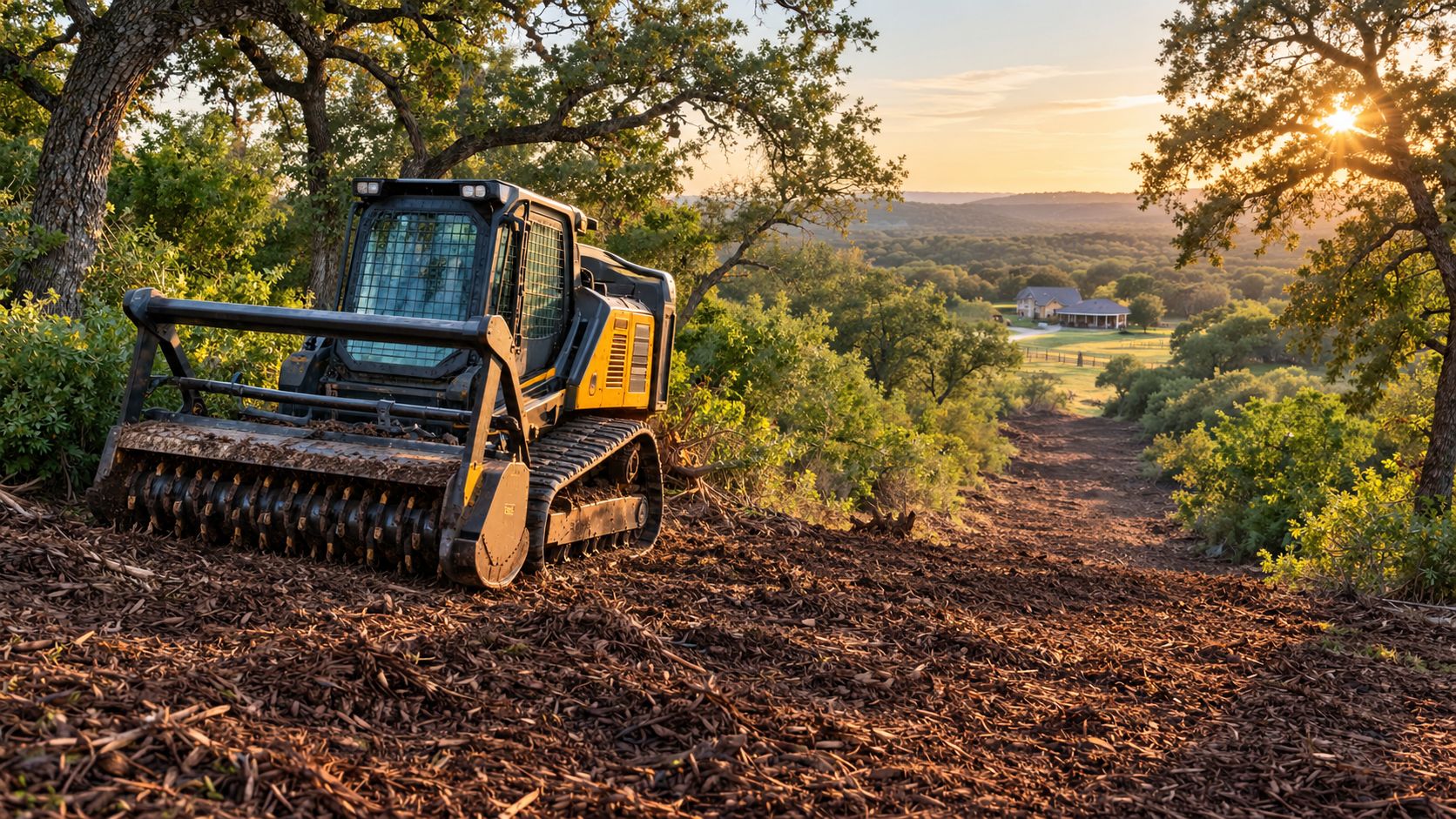
Selective forestry mulching typically averages about $530 per acre, with realistic costs ranging from roughly $335 to $1,395 per acre depending on vegetation density and site conditions. That price can make a mulching service a practical first step, but it doesn't make every acre build-ready.
You may be standing on recently purchased Texas acreage with a very simple goal: make the property usable without stripping it bare. The old pasture has disappeared under cedar, yaupon, mesquite, or volunteer trees. A fence line is somewhere behind the brush. The route to a future homesite exists on a survey, but not on the ground.
Two contractors can look at the same property and recommend very different work. One may suggest grinding selected vegetation in place to reopen access and improve visibility. Another may recommend dozing, grubbing, hauling, and grading because the owner wants a driveway, septic field, or building pad. Both recommendations can be right. The deciding factor is what the land needs to become after the equipment leaves.
The forestry mulcher market reached USD 1.29 billion in 2024 and is projected to reach USD 2.15 billion by 2033, at a 5.8% CAGR, according to this forestry mulcher market overview. A separate estimate places the agricultural and forestry mulchers market at USD 2.1 billion in 2024, with a projection of USD 3.5 billion by 2033, as reported in this agricultural and forestry mulchers market estimate. Those figures don't tell you what your property needs, but they do reflect how widely mulching equipment and related services are used for land management and infrastructure work.
Table of Contents
- Why Mulching Services Matter for Acreage Today
- Forestry Mulching Explained
- Forestry Mulching vs Landscape Mulching
- What Mulching Services Cost and Deliver
- When to Choose Forestry Mulching
- Planning Mulching as Part of Long-Term Land Improvement
Why Mulching Services Matter for Acreage Today
A new landowner often starts with a visual problem. The property looks closed in, rough, and neglected. The first instinct is to ask for “clearing,” as though clearing were one uniform service with one finished result.
It isn't. A rural acreage project might involve opening a livestock route, reclaiming pasture, exposing a fence corridor, protecting mature oaks, or creating a defined area for a future house. Those goals overlap, but they don't require the same level of disturbance.
One property can need two different approaches
Consider an overgrown Texas tract with mature trees near the road, dense brush through the middle, and a proposed homesite toward the back. A selective mulching pass could open a practical access route, reduce understory, and make the terrain easier to inspect. It could also preserve the trees that give the property shade and character.
That same pass wouldn't necessarily prepare the homesite for construction. If the future building area needs root removal, soil stripping, drainage work, or finished grades, the owner will need a separate site-preparation phase. Treating the entire tract as a building pad would create unnecessary disturbance, while treating the building pad like a trail would leave the project incomplete.
Practical rule: Define the finished use of each area before choosing the machine or method.
Mulching services matter because they let landowners improve difficult acreage in stages. Processed vegetation stays on the ground where appropriate, access improves, and the owner gains a clearer view of what should happen next. That can be more useful than rushing into blanket removal before the property's layout and priorities are understood.
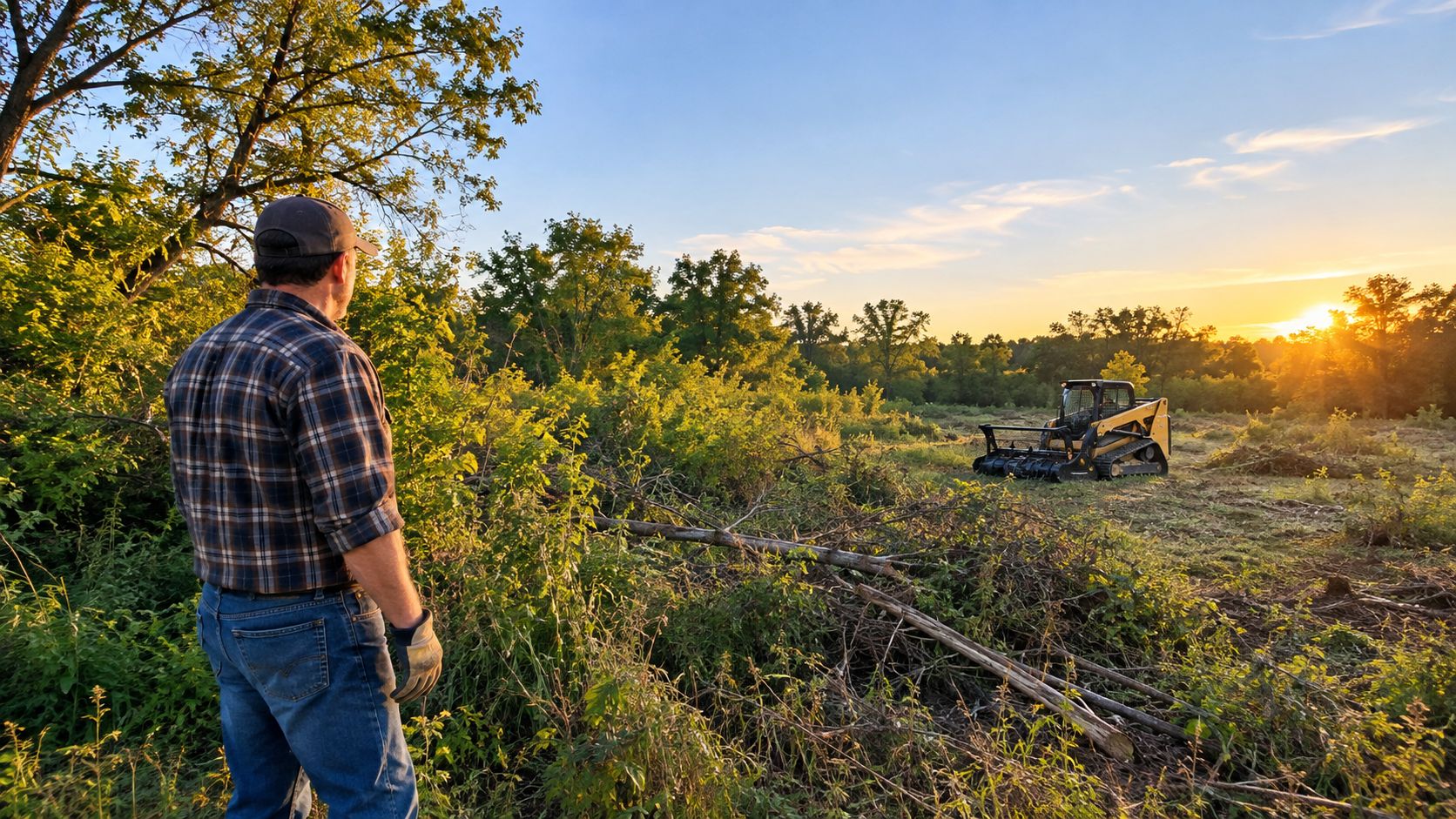
A careful scope also prevents a common mistake: paying to remove vegetation that was providing shade, habitat, erosion protection, or visual screening. The right question isn't “How much can the mulcher remove?” It's “Which vegetation is interfering with the property's intended use, and what should remain?”
Forestry Mulching Explained
A forestry mulcher uses a rotating drum fitted with cutting teeth to engage standing brush, saplings, and woody growth. The head cuts and grinds vegetation close to the ground, reducing much of the material into chips or mulch rather than placing whole trees and brush into piles.
The processed material generally remains on-site. That changes the job's logistics because the operator isn't automatically loading, hauling, and disposing of every limb and trunk. It also changes the finished appearance. The result isn't the same as a scraped site or a neatly hauled clearing. It is a managed ground layer over land where woody vegetation has been reduced in place.
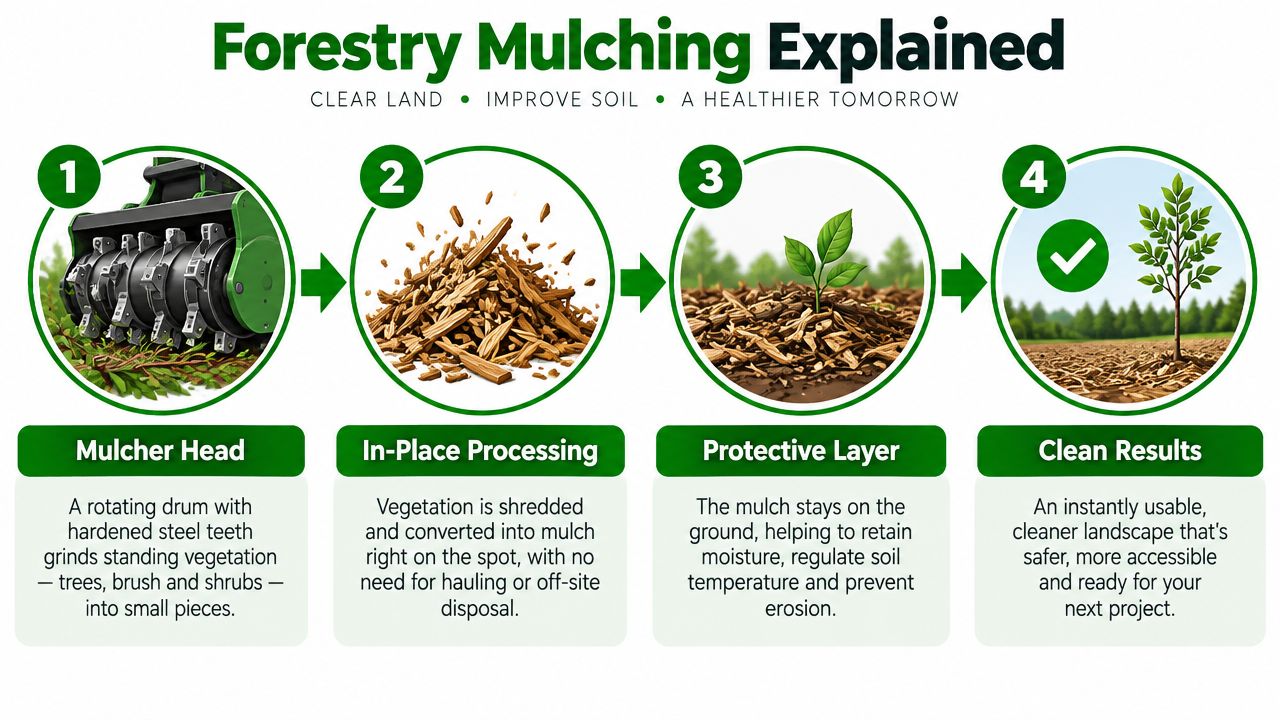
What happens during a mulching pass
The operator first needs a workable route and a clear understanding of what stays. Mature trees, boundary features, utilities, drainage areas, structures, and sensitive locations should be identified before cutting begins.
The mulcher then works through the target vegetation. Productivity depends on whether the machine can keep cutting or must repeatedly reposition around rocks, steep ground, hidden debris, narrow access, and trees that need protection. A dense stand of similar-sized brush may move efficiently, while scattered heavy stems across uneven terrain can take much longer.
The method suits areas where the owner wants access, visibility, and vegetation control without removing every trace of organic material. Trail corridors, pasture edges, fence lines, and homestead perimeters often fit that description. A landowner who wants to understand the reasoning behind leaving material in place can also review why mulching can be preferable to scraping.
The USDA forest-operations guidance reports average operating costs of about $530 per acre, with a range of $335 to $1,395 per acre, depending on vegetation, machine size, and site conditions, as detailed in this forestry mulching cost study. The range makes sense in the field. An acre isn't priced only by its map area. It's priced by how much productive cutting the operator can complete within that area.
Why selective work changes the result
Selective clearing doesn't mean the operator drives around at random. It means the scope distinguishes desirable trees and useful vegetation from growth that blocks the intended use. That distinction protects the property's character while creating room for roads, livestock movement, recreation, or future improvements.
A mulcher can improve a site quickly, but it doesn't magically change soil structure or remove buried roots. That limitation is central to deciding whether mulching is the right first move or only one part of a larger plan.
Forestry Mulching vs Landscape Mulching
Garden mulching and forestry mulching share a word, but they solve different field problems. Garden mulching usually involves placing a selected mulch material around ornamental beds, trees, gardens, or maintained residential areas. The work is focused on appearance, planting conditions, edge definition, and controlled coverage.
Forestry mulching is a vegetation-reduction process. The operator brings a machine capable of cutting through dense brush, volunteer trees, and woody overgrowth that a landscaping crew wouldn't normally handle with bed-maintenance tools.
Match the service to the property
A maintained home with ornamental trees and defined planting beds may need mulch installed around those areas. The crew is working with an existing design and adding material to support that design.
A rural property with a hidden fence line has a different problem. The operator may need to cut through unmanaged woody growth, expose the corridor, and leave the processed material in place. That is a forestry mulching scope, not a bed-mulching project.
| Property need | More suitable approach | Expected focus |
|---|---|---|
| Ornamental beds and garden areas | Landscape mulching | Controlled material placement and finished appearance |
| Dense brush and volunteer trees | Forestry mulching | In-place processing of woody vegetation |
| Pasture reclaimed for grazing or mowing | Forestry mulching, followed by site-specific maintenance | Reopening usable ground while preserving selected trees |
| Fence-line access | Selective forestry mulching | Exposing the corridor for fencing and inspection |
| Defined homesite area | Forestry mulching may be an initial phase | Vegetation reduction before additional site preparation |
| Finished building pad | Full site preparation | Grubbing, stripping, drainage, and grading as required |
The distinction matters when an owner uses a broad phrase like “mulch the property.” A contractor needs to know whether that means spreading material in a maintained yard or grinding standing vegetation across rural acreage.
Where the approaches overlap
Some residential acreage needs both. A home may sit inside a cleared envelope with garden beds around it, while the outer perimeter contains brush that needs forestry mulching. Treating the two areas as one service can produce the wrong finish and the wrong equipment plan.
The same applies to a homestead. A garden zone may need a controlled, clean surface, while an access route can benefit from in-place processing. A pasture edge may need selective clearing, but the future driveway may need excavation and grading.
A good scope names the desired result for each zone. “Leave mulch on-site” might be appropriate along a trail. It may not be appropriate where a slab, septic system, or gravel drive will be installed. The material, roots, and ground profile all matter.
What Mulching Services Cost and Deliver
A mulching service doesn't have a reliable flat price per acre because acres behave differently. A level parcel with consistent brush and direct equipment access gives the operator more productive cutting time. A steep, rocky, irregular tract with scattered large stems can consume time through maneuvering, inspection, repositioning, and equipment wear.
USDA forest-operations guidance reports average operating costs of about $530 per acre, with reported costs ranging from $335 to $1,395 per acre based on vegetation type, machine size, and site conditions in this published cost analysis. Use that range as a planning reference, not as a promise for a particular Texas property.
The factors behind the quote
A contractor should evaluate more than acreage. The scope and price can change with:
- Vegetation density: Thick, continuous growth may allow steady production, while scattered stems can require more maneuvering.
- Stem size and hardness: Larger or tougher material places more demand on the head, teeth, fuel, and operator.
- Slope and terrain: Uneven ground reduces speed and can restrict the machine's working position.
- Access and staging: A narrow entrance, wet route, or distant work area can complicate mobilization and movement.
- Desired selectivity: Protecting mature trees and other keep areas requires deliberate positioning rather than broad passes.
- Finished use: A trail, pasture edge, fence corridor, and homesite each require a different level of cleanup and follow-up work.
The acreage number alone can't tell you how many productive hours the work will require. A contractor who walks the property can identify where the machine will cut continuously and where the operator will spend time navigating around constraints.
What you should expect after the pass
A successful forestry mulching project can create a clearer route, improve sightlines, reduce dense woody growth, and make neglected acreage easier to inspect and manage. It may also leave an organic layer on the ground instead of piles of whole brush awaiting removal.
It won't necessarily create a smooth lawn-like surface. Hidden rocks, stumps, roots, uneven soil, and residual woody material may remain. If the goal is a driveway or building area, ask specifically whether the quoted work includes excavation, stump removal, soil preparation, or grading. Those tasks are not automatically included in a mulching pass.
For a broader comparison of cutting methods and where brush cutting fits, review this brush cutting service guide. The important budgeting question is not just what the service costs. It's whether the proposed scope delivers the ground condition you need for the next use.
When to Choose Forestry Mulching
Choose forestry mulching when the main problem is unwanted woody vegetation and the desired result is usable, navigable, manageable land, not engineered bare ground. That often includes recreational trails, livestock access routes, pasture edges, fence corridors, and overgrown acreage where selected mature trees should remain.
Start with the intended use, then divide the property into work zones. A trail can be treated differently from a future barn site. A fence corridor can be opened without clearing the entire boundary. A homestead perimeter may need visibility and access while retaining shade trees.
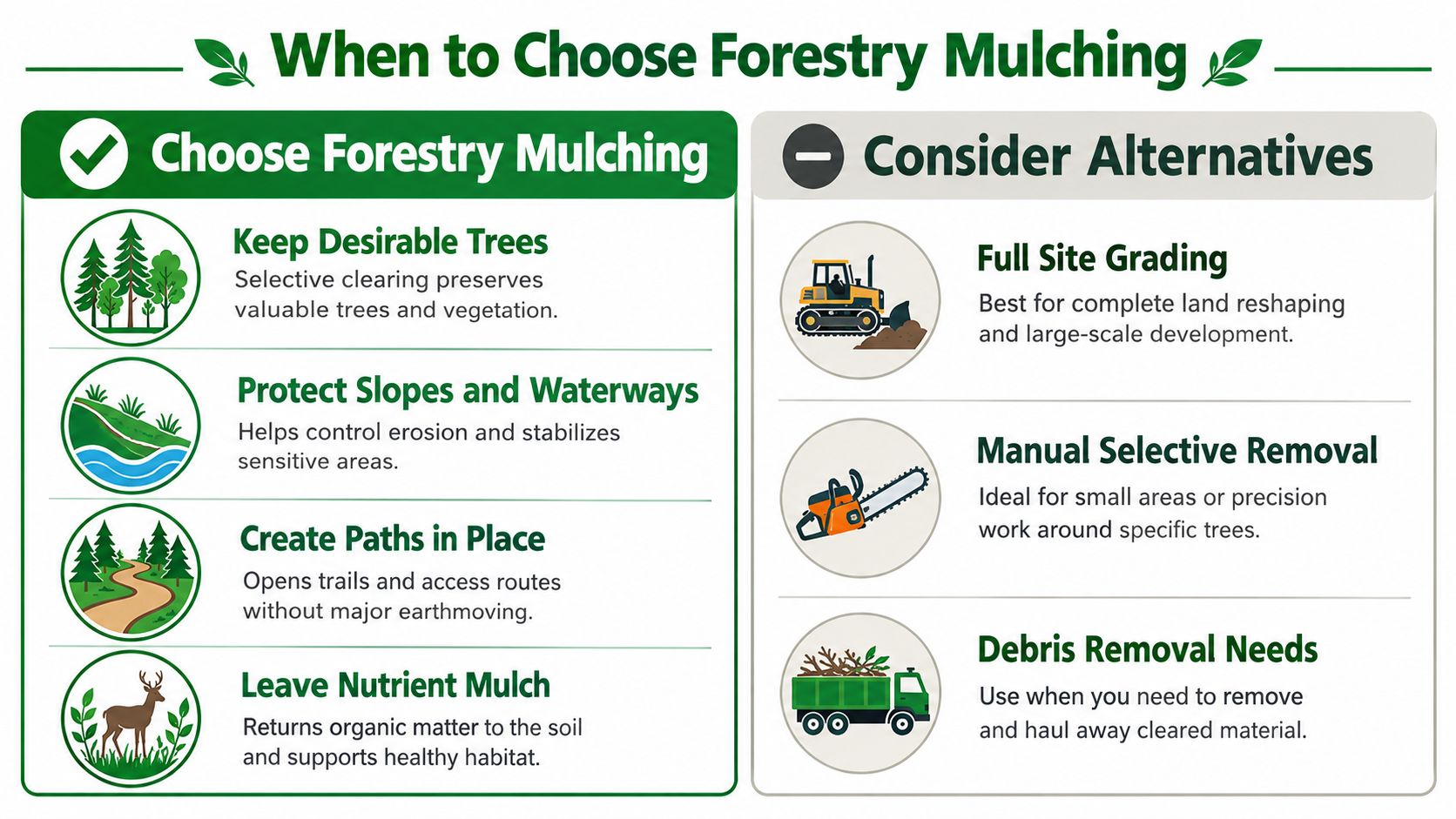
Good fits for a mulching-first scope
Forestry mulching usually makes sense when you want to:
- Open trails: Create routes for trucks, tractors, ATVs, livestock, or foot traffic while following the terrain.
- Reclaim pasture: Reduce woody encroachment so the area can return to grazing, mowing, or additional land management.
- Expose boundaries: Reopen fence lines for construction, inspection, surveying, and maintenance.
- Improve visibility: Clear selected understory around a home, road, or property edge without removing every mature tree.
- Manage recurring growth: Maintain previously improved acreage before brush again closes access.
A 2025 field study on stump mulching reported that a remote-controlled carrier with a 36 kW, or 50 hp, engine, a 110 cm working width, and 32 fixed teeth treated a hectare in less than 3.5 scheduled machine hours, processed more than 60 stumps of about 30 cm diameter per hour, and recorded a treatment cost of 202 €/ha, as described in the peer-reviewed stump-mulching field study. That result illustrates how machine design and material size can support productive work within a tool's intended operating envelope. It isn't a guarantee for a different machine, terrain, or Texas property.
Know when mulching stops being enough
Forestry mulching generally leaves stumps and root systems in place. That works for vegetation control, access routes, pasture edges, and trails, but it doesn't replace grubbing, stripping, excavation, or grading where the finished ground must support construction or engineered drainage.
For a driveway, septic field, or building pad, plan for a separate site-preparation scope. The practical sequence is often to mulch first for visibility and access, then perform stump work and earthwork only within the areas that need a construction-ready surface. Independent guidance on the boundary between forestry mulching and full site preparation reinforces that distinction.
If the next contractor needs to set forms, install a septic system, or establish a finished grade, ask whether the ground condition after mulching will actually support that work.
Planning Mulching as Part of Long-Term Land Improvement
The strongest land-improvement plans start with use, not maximum removal. Mark the future home, pasture, trails, fencing, drainage features, and keep areas before equipment arrives. Then use selective mulching to solve the immediate access and visibility problems without committing the entire property to one finished condition.
A phased approach also leaves room to learn how the land behaves. After the first opening, you may discover a better trail route, a drainage issue, desirable trees hidden in the brush, or an area that needs different treatment. Pasture reclamation planning can help connect the initial clearing decision to grazing, mowing, and ongoing maintenance.
Plan follow-up work for regrowth, fence access, trail condition, and areas that will eventually receive construction. Mulching can turn difficult acreage into manageable land, but the lasting result comes from maintaining the routes and boundaries you opened.
Fieldmark Land Co. offers forestry mulching, selective clearing, brush removal, pasture reclamation, fence-line clearing, trails, access improvements, and homesite preparation for rural properties around San Antonio and South-Central Texas. If you need help separating a mulching phase from true build-ready site prep, visit Fieldmark Land Co. to request a property walkthrough and discuss a scope built around how you'll use the land.