Cedar Clearing Guide for Texas Hill Country Acreage
Practical cedar clearing guide for Texas Hill Country acreage. Learn why cedar invades, when to clear, methods that work, and how to manage regrowth.
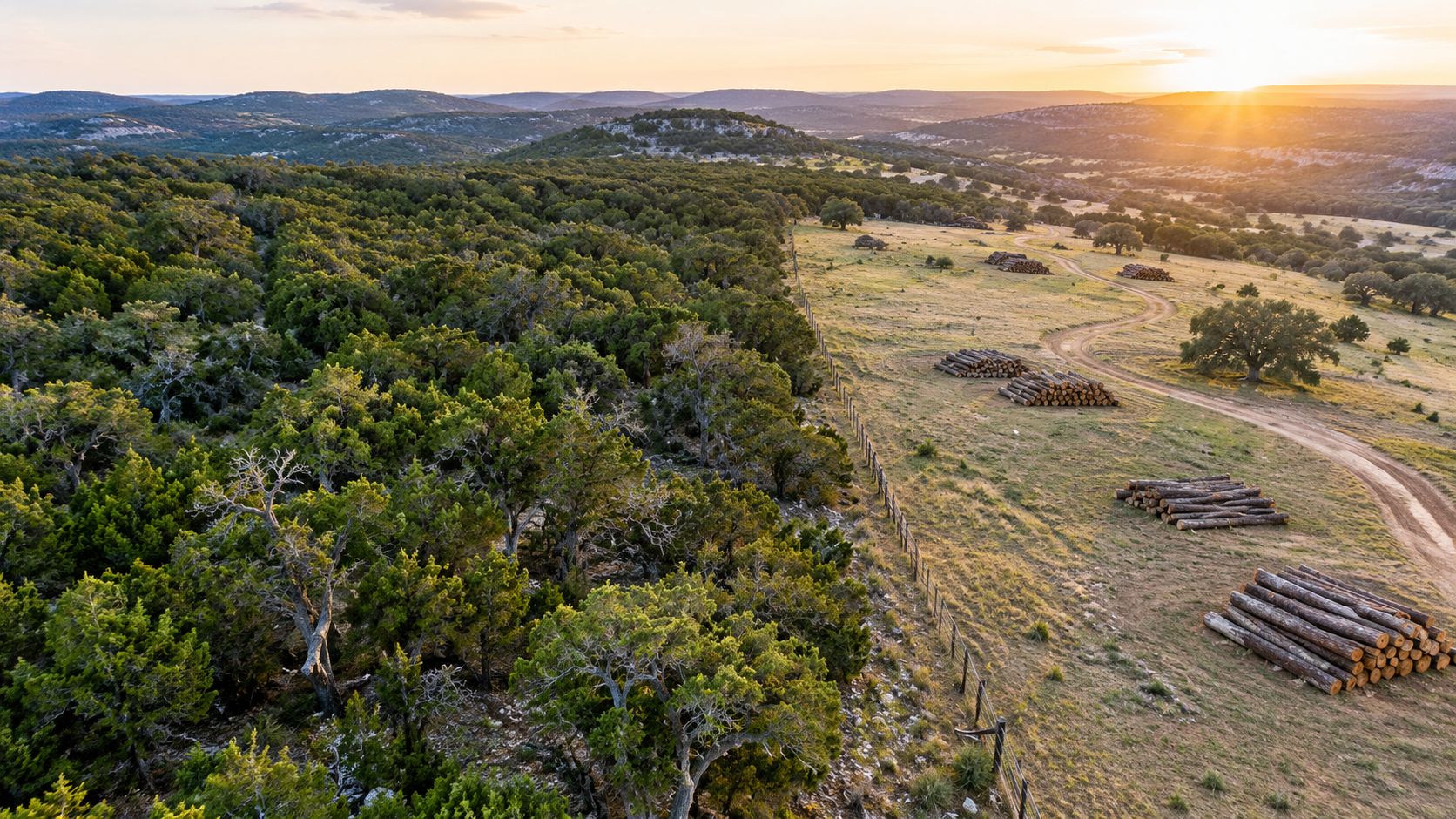
You step through the gate and realize the property has changed. Cedar has closed around the old fence line, young trees crowd the base of live oaks, and a route that looked open from the road now disappears into green. After a year or two of watching usable ground shrink, the question isn't whether to clear. It's what to clear, how far to go, and what the land should do afterward.
Around San Antonio and across the Texas Hill Country, cedar clearing works best as an ongoing land-stewardship decision, not a one-time cleanup. The right plan depends on whether you're restoring pasture, protecting a homesite, opening access, improving a viewshed, preparing for fencing, or managing a recreational tract. This guide covers the biology behind the spread, the practical reasons landowners act, the main removal methods, the partial-versus-full clearing decision, seasonal timing, and the maintenance that keeps cleared acreage functional.
Table of Contents
- Why Cedar Clearing Is on Your Mind
- What Cedar Is and Why It Takes Over
- What Landowners Are Actually Solving
- Methods That Work on Hill Country Acreage
- Selective Clearing Beats Blanket Removal
- Timing the Work to Match Your Property
- Regrowth, Erosion, and What Comes Next
- Putting It Into a Plan You Can Start This Week
Why Cedar Clearing Is on Your Mind
A stock tank takes longer to reach. Fence checks turn into slow walks through brush. Cattle avoid ground that once carried forage, while a planned homesite disappears behind trees. Those are the points when landowners around San Antonio usually call a contractor. The problem is no longer appearance. Cedar is interfering with how the property needs to work.
That frustration can produce an unnecessarily broad scope. “Clear the cedar” might mean reopening a driveway, reclaiming pasture, creating defensible space near a house, or removing woody growth across the entire tract. Each objective brings different equipment needs, costs, disturbance, and follow-up work.
Practical rule: Define what the acreage must do before deciding how much cedar to remove.
Cedar often moves into the ground owners need most, including flats, fence corridors, old fields, road edges, and areas near structures. Dense stands can reduce forage, limit usable acreage, increase recurring control work, and create continuous fine fuel near improvements. Oklahoma's scale shows how quickly the problem can expand. A conservation fact sheet reported that 8 million of the state's 17 million grassland acres had at least 50 redcedars per acre, while infested acreage had increased 400% over the previous 50 years (Oklahoma's eastern redcedar fact sheet).
Total removal is only one option. Open ground may need a full clearing, while rocky slopes, wildlife cover, or screening areas may benefit from thinning. Walk the tract and mark three zones before equipment arrives: ground that must open fully, ground that should be thinned, and ground that should stay covered. Then assign each zone a method, season, and follow-up plan.
What Cedar Is and Why It Takes Over
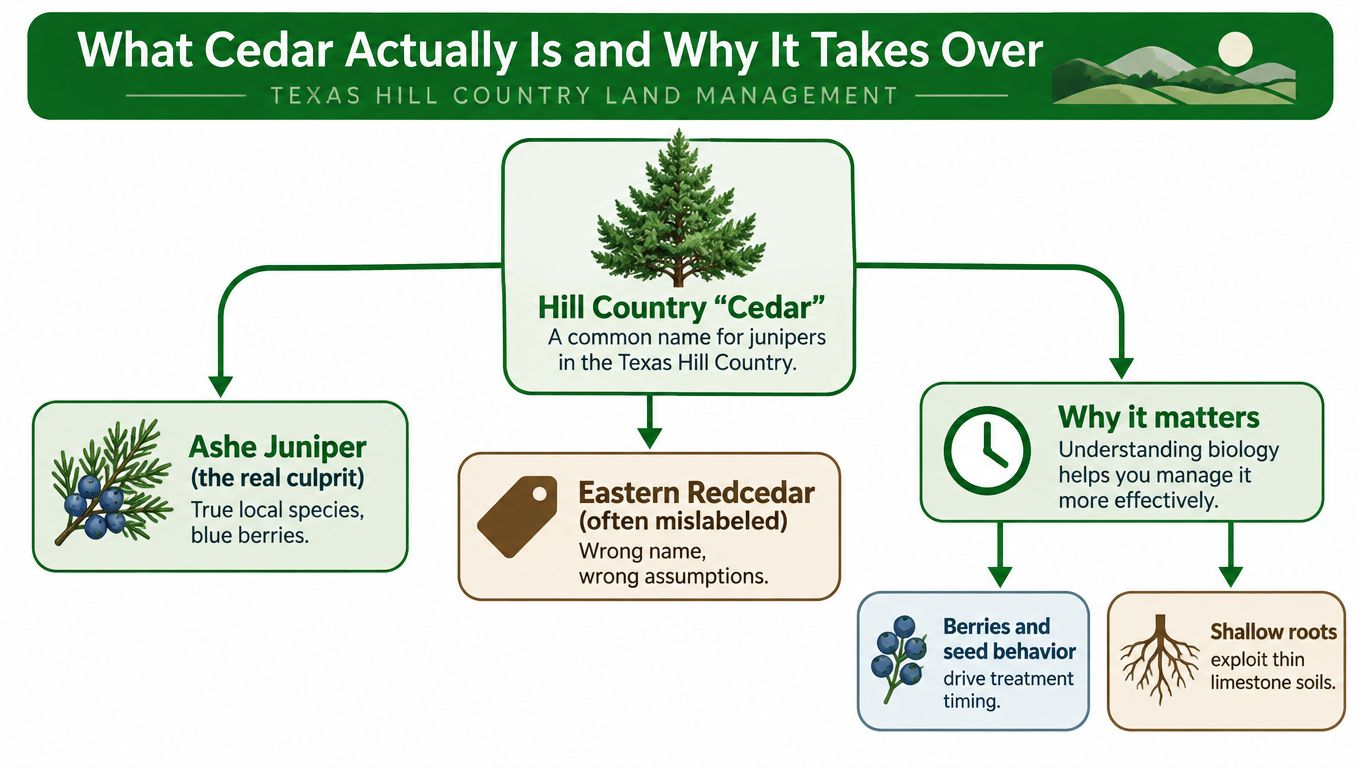
The tree called Hill Country cedar is usually Ashe juniper, not the eastern redcedar named in many general land-management discussions. That distinction affects seed movement, growth behavior, treatment methods, and the timing a contractor should use on San Antonio acreage.
Biology sets the work plan
Ashe juniper tolerates drought, establishes in thin limestone soils, and competes aggressively where grasses have weakened. Its shallow roots can use small pockets of soil across rocky ground, while wildlife spreads berries beyond the original stand. Once mature trees produce seed beside open ground, seedlings can appear along roads, fence lines, drainages, and disturbed areas.
The seed bank is easy for new landowners to underestimate. Removing visible trees changes the light reaching the soil, but it does not remove every viable seed already present. A site may look finished when machinery leaves, then require repeated attention as new seedlings emerge.
Land use also shaped the problem. Regular fire once limited young juniper in many grassland systems, while heavy grazing reduced the grass cover competing with seedlings. Fire exclusion, overgrazing, and repeated disturbance created more opportunities for cedar to establish, especially in rough areas that were difficult to burn or manage.
Why the species distinction matters
Calling every juniper “cedar” is common, but treating that name as a minor detail can lead to poor field decisions. A crew that tops trees may leave viable root crowns and deliver only a short-lived visual improvement. A plan that ignores seed timing may clear one area while nearby berries continue spreading into ground being restored.
Cedar encroachment is a land-management issue tied to forage, access, water, habitat, and fire behavior. The Oklahoma conservation fact sheet describes eastern redcedar spreading rapidly and records substantial economic losses tied to its expansion. Those figures describe Oklahoma, not a Texas project estimate, but they show why passive recovery rarely works once cedar dominates.
The practical question is how much of the problem your property needs to solve. Full removal may suit ground intended for pasture, access, or construction. Partial clearing may better fit rocky slopes, wildlife cover, or screening areas. That choice turns cedar clearing into an ongoing stewardship decision, not a one-time cleanup. The remaining trees, exposed soil, seedling response, and intended use all shape the follow-up work.
What Landowners Are Actually Solving
A cedar-clearing project should begin with the job the acreage needs to perform. Walk the property and mark what the trees are blocking: a ranch road, fence line, pasture, homesite, fuel break, or view. That answer determines whether the right scope is a narrow corridor, one open pasture, or a selective program carried out over several seasons.
Access often drives the first clearing
Cedar can close roads, trails, gates, and fence lines before it covers an entire pasture. Removing trees from those corridors gives trucks, tractors, livestock, and maintenance crews dependable passage. It also simplifies boundary checks and future fence construction.
Access work is usually a practical first phase because it improves the rest of the property-management work. A clear route lets equipment reach problem areas and gives you a usable line for inspecting regrowth after rain.
Homesites and barn areas need a different standard. The target is a defined work area with room for construction and maintenance, while useful shade, mature hardwoods, and natural drainage remain outside the building footprint. Clearing every tree around a homesite can expose soil, change runoff, and remove cover that may still serve the property.
Forage recovery requires light and follow-up
Dense cedar shades grass, catches litter, and reduces usable ground beneath the canopy. Opening selected pasture zones can help native or introduced grasses return, but tree removal alone does not create forage. Protect the soil, choose suitable seed where needed, account for rainfall, and adjust grazing after the clearing.
The Nebraska cedar-control review shows how treatment method and project scale affect the decision. From 2004 to 2013, the Natural Resources Conservation Service supported mechanical treatment on 138,869 acres and prescribed burning on 96,328 acres. Average costs were $53.81 per acre for mechanical removal and $7.34 per acre for prescribed burning. Those figures explain why fire can treat broad, connected areas efficiently when conditions permit, while mechanical clearing remains useful where selectivity, access, or terrain controls the plan (the Nebraska cedar-control review).
Fire safety and water management need judgment
Fine, resinous cedar foliage can carry fire rapidly when dense stands connect fuel near homes, roads, or access routes. Removing crowded trees near structures and thinning farther out can interrupt that continuity without stripping every slope.
Water is a common reason for clearing, but the expected result depends on the site. Texas Living Waters notes that reducing brush cover doesn't automatically increase water yield. Soil depth, geology, rainfall, and the vegetation removed all affect the outcome. Texas watershed studies have reported gains ranging from about 35,000 gallons per acre per year in a 40-acre watershed study to roughly one additional acre-foot of recharge for every 8 acres of juniper cleared in a 2007 progress report (the Texas brush-management review).
The partial-versus-full decision belongs in every scope. Full removal may fit pasture, construction, or major access work. Partial clearing can better protect rocky slopes, wildlife cover, screening, and soil. Cedar clearing is therefore an ongoing stewardship choice, with follow-up based on the trees retained, exposed ground, seedling response, and intended use.
| Motivation | Property outcome |
|---|---|
| Access restoration | Open roads, trails, gates, and fence lines for vehicles, livestock, and inspections |
| Forage recovery | Reclaim selected pasture where canopy and woody competition have reduced grass production |
| Wildfire planning | Break dense fuel continuity near homes, roads, and critical access corridors |
| Water management | Target brush in suitable uplands while protecting soil, drainage, and revegetation |
| Homesite preparation | Define building and work areas without clearing the entire tract |
| Pre-sale preparation | Improve visibility, buyer access, photography, and the apparent usability of acreage |
Methods That Work on Hill Country Acreage
A cedar job can look straightforward from the road and become a different project once the crew reaches steep limestone, retained oaks, fences, and narrow access. The right method depends on what the ground needs to do afterward. Mulching, cutting, piling, burning, and prescribed fire each solve a different part of the problem, and none fits every tract.
Forestry mulching
A forestry mulcher grinds standing brush and small trees in place, leaving organic material across the soil. It suits accessible ground where the owner wants better travel, less hauling, and a finished surface that still looks relatively natural.
Mulching does not guarantee that every cedar is dead. Mature trees cut above the root crown may resprout or remain capable of regrowth. A heavy layer of mulch can also suppress desirable seedlings if it is left too thick. The operator needs enough room to work around retained oaks, fences, tanks, and rocky outcrops without turning selective clearing into collateral damage.
Hand and mechanical cutting
Chainsaws, hydraulic shears, and skid-steer-mounted cutters give crews tighter control around slopes, hardwoods, structures, and irregular boundaries. This approach fits properties where the clearing map matters more than the production rate, especially when one tree stays and the next one goes.
The trade-off is cleanup. Cut material may need to be mulched, piled, burned, or left in selected places for habitat and soil cover. Stumps and root crowns also require a treatment decision. Without one, a property can look open briefly before regrowth returns.
Piling and burning
Piling and burning can work for dense stands with suitable access, safe separation, and enough room to manage smoke and ash. It removes large volumes of woody material without hauling every load away, but the job requires a burn plan, favorable weather, compliance with local restrictions, and a realistic approach to erosion control.
A pile that is easy to build is not automatically easy to burn safely. Structures, public roads, neighbors, and overhead utilities can narrow the safe operating area. Burned or scraped patches may need reseeding and monitoring, particularly where exposed soil can move during heavy rain.
Prescribed fire
Prescribed fire is most useful as part of a managed grassland program. Trained practitioners coordinate weather, fuel, smoke, equipment, and escape contingencies before lighting a burn. Fire can control young cedar and recycle nutrients, but mature trees usually require another treatment.
Prescribed burning typically treats larger average projects than mechanical removal, which suits connected acreage better than isolated parcels. Mechanical clearing remains the tighter option around homes, fences, access routes, and other specific landowner objectives. The method should follow the property's intended use, not the convenience of applying one treatment everywhere.
For a broader overview of brush-removal planning, compare the practical considerations in Fieldmark's brush-clearing guide.
| Method | Best terrain | Typical cost per acre | Ground condition after | Resprout risk |
|---|---|---|---|---|
| Forestry mulching | Accessible ground with room for tracked equipment | Varies by density, access, and scope | Mulch remains on site and soil disturbance can stay limited | Moderate if root crowns remain |
| Hand and mechanical cutting | Rocky, steep, irregular, or highly selective sites | Varies with labor, density, and cleanup | Cut material requires treatment or removal | Moderate to high without follow-up |
| Piling and burning | Open areas with safe burn access and suitable conditions | Often lower for dense acreage where burning is allowed | Ash and disturbed patches may need stabilization | Depends on remaining roots and seed bank |
| Prescribed fire | Connected grassland and coordinated burn blocks | Often efficient at broad scale | Ash and renewed grass growth, with site-specific erosion risk | Effective on young cedar, limited on mature trees |
Selective Clearing Beats Blanket Removal
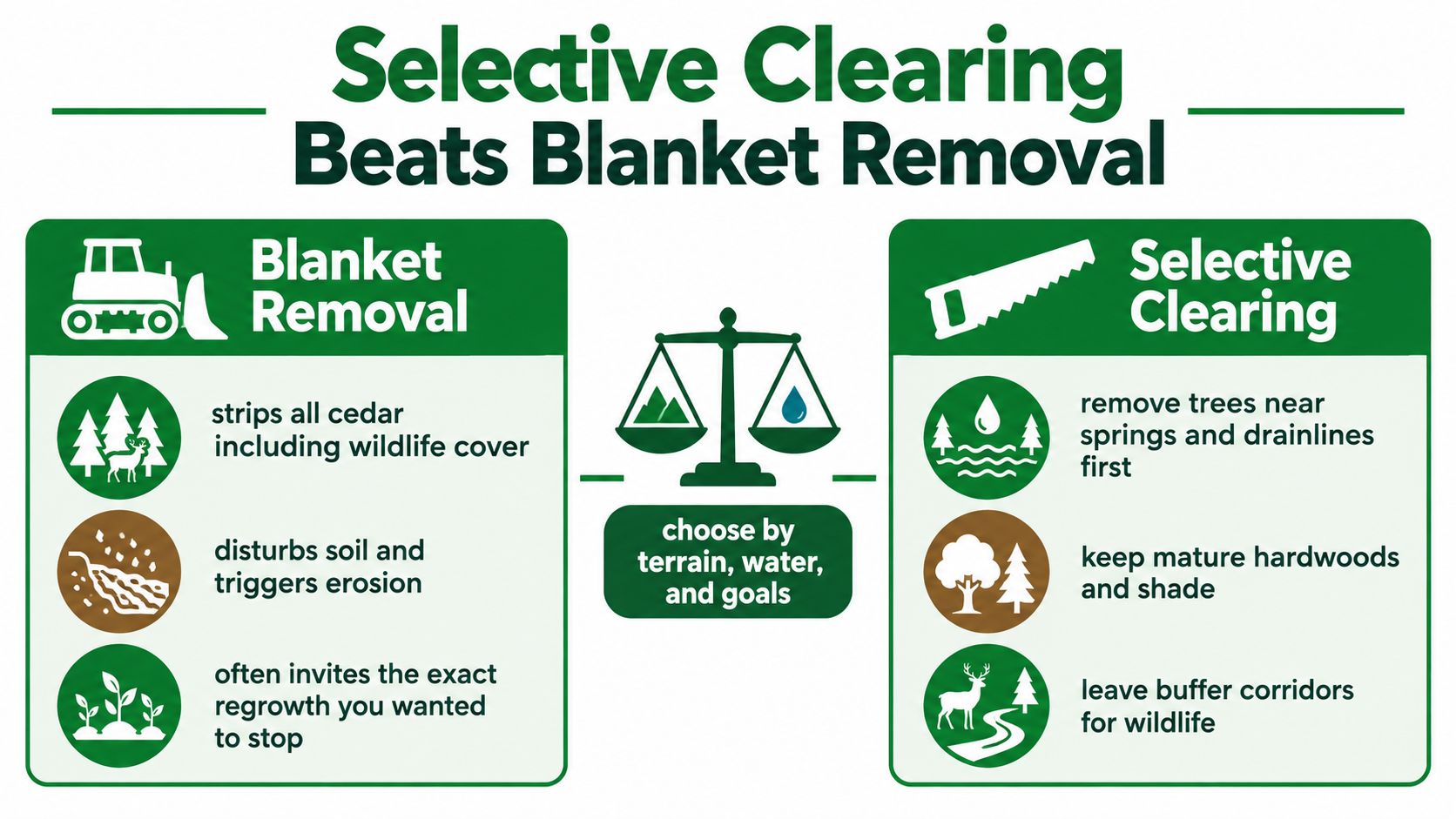
Mowing every cedar off a Hill Country tract can create problems that weren't visible during the estimate. Remove all cover from a shallow slope and the first hard rain may move soil. Strip a draw of woody protection and you may lose shelter, wildlife structure, or a natural break in wind. Clear a stand without planning grass establishment and the seed bank gets sunlight before the desired plant cover is ready.
Selective clearing gives each part of the property a job. Keep cedar where it stabilizes difficult ground or contributes to shelter. Remove it where it blocks a fence, competes with pasture, crowds a spring, or creates a continuous fuel corridor near a structure.
A useful field decision
Walk the property by use, soil, and slope rather than by tree count.
- Clear fully: Building pads, defined work yards, primary access routes, fence corridors, and selected pasture flats usually need a clean outcome.
- Thin selectively: Areas near homes, roads, drainages, and grazing zones often benefit from spacing and fuel-continuity breaks rather than complete removal.
- Leave alone: Rocky slopes, draws, north-facing ground, wildlife cover, and erosion-sensitive areas may need standing vegetation or a distributed canopy.
Texas Hill Country guidance recommends removing dense cedar within 30 feet of structures and selectively thinning from 30 to 200 feet to interrupt fuel continuity while retaining some cover to reduce exposed soil and erosion risk (the Texas Hill Country wildfire guide). Those distances are planning guidance, not a universal clearing prescription, so the final boundary should reflect slope, access, structures, and local conditions.
A cedar tree isn't automatically a problem. Its location and function decide whether it stays.
Recent land-management discussion has also moved toward partial treatment. One 2026 FAQ states that removing about 50% to 60% of cedar can capture much of the benefit while reducing erosion exposure and cost, though that figure should be treated as a site-specific planning reference, not a rule for every property (the Sierra Club Texas discussion). A contractor should be able to show you on a map why each zone is being cleared, thinned, or retained. For a property-specific approach, selective clearing services from Fieldmark Land Co. describe work organized around retained trees, access, terrain, and intended use.
Timing the Work to Match Your Property
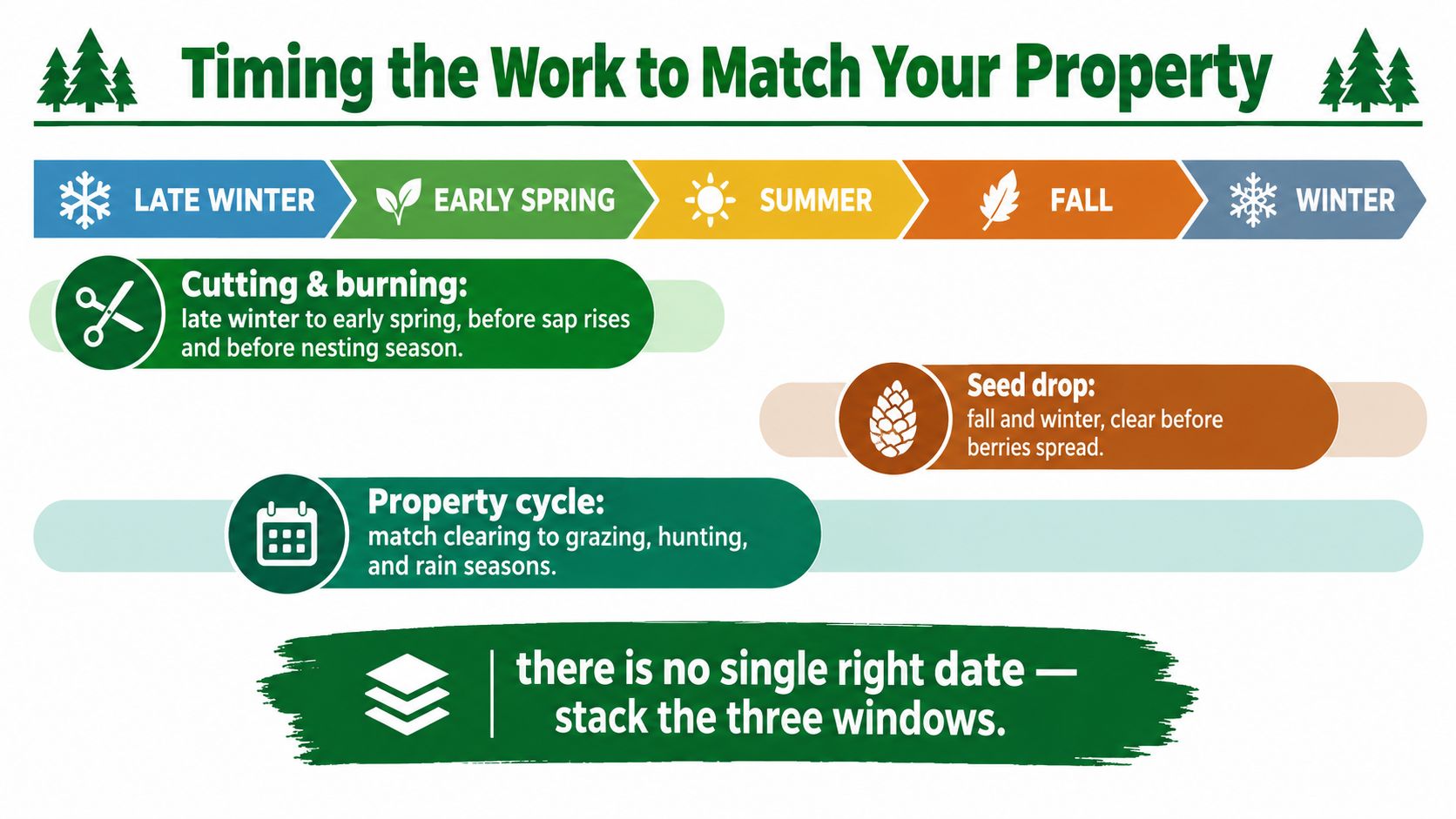
There isn't one perfect cedar-clearing date. Timing has three parts, and the project works better when all three line up.
Seasonal timing
Late winter and early spring often provide a workable window for cutting and burning before sap movement increases and before nesting activity becomes a concern. Burning still depends on fuel moisture, wind, humidity, permits, and local restrictions. No calendar date overrides a burn ban or unsafe conditions.
Seed movement matters too. Fall and winter can bring berry dispersal, so a landowner planning treatment should consider whether nearby mature trees are continuing to seed the ground being restored.
Growth stage and project sequence
Small saplings and young poles are easier to control than mature trees with established crowns and root systems. Early treatment can reduce the amount of follow-up work, while cutting the tops off larger trees may leave a problem below ground.
The project also needs to fit the rest of the property plan. Clear fence corridors before posts and wire are installed. Assess soil, slope, and forage before paying for seed. Finish heavy equipment work before a homesite or barn pad is staked, so machines don't compact newly exposed ground or create unintended drainage paths.
Choose the clearing window first, then work backward from fencing, reseeding, grazing, and construction.
Regrowth, Erosion, and What Comes Next
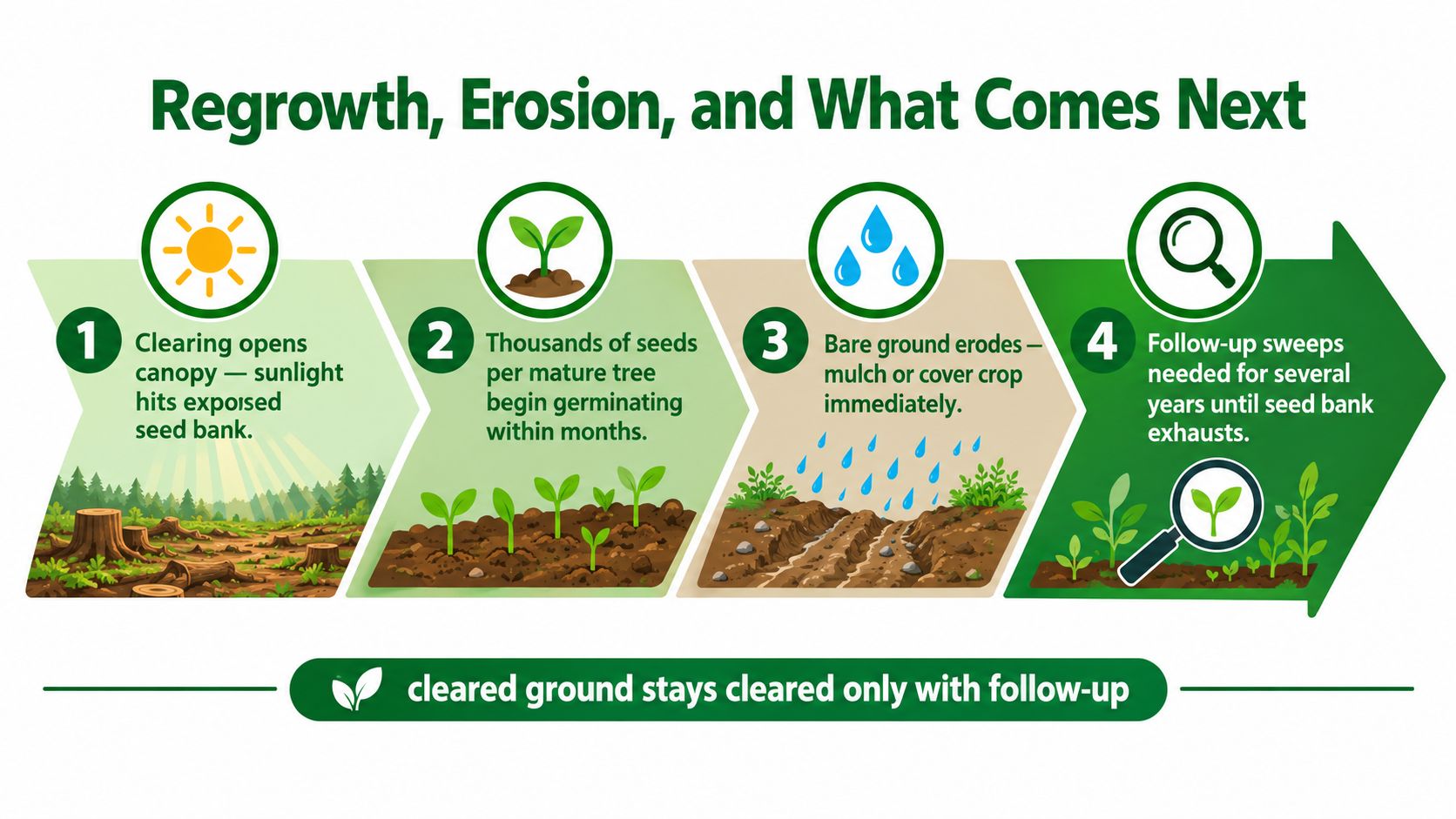
A cleared opening can look finished when the equipment leaves, yet the property may still be entering its most demanding phase. Cedar seeds can remain in the soil, and new sunlight can trigger another flush of seedlings. Cut trees also need follow-up when root crowns remain untreated or the work removed only the visible canopy.
Protect the soil before chasing perfection
Hill Country slopes can lose soil quickly when canopy, leaf litter, and root protection are disturbed. Revegetation and erosion control determine whether cleared ground holds soil and water. Root mats left in place on a slope can hold soil through the first wet season even when the canopy is gone.
Keep those roots intact where practical, avoid unnecessary grading, and establish suitable grass cover as conditions allow. Little bluestem and sideoats grama may fit a restoration plan, but seed selection, soil preparation, rainfall, and grazing pressure determine whether they establish. Straw or compost can protect disturbed cuts when applied without smothering emerging plants.
Build follow-up into the original scope
Walk the property during the first growing season, paying close attention to fence lines, water gaps, roads, and the edges of cleared zones. Hand-pulling or spot treatment may control scattered seedlings. Denser return growth can require another mechanical pass, so partial clearing should include a realistic maintenance route and budget.
A practical follow-up plan includes:
- First growing season: Inspect new openings and protect bare soil with appropriate cover.
- Following spring: Remove seedlings and address cut stumps or missed trees before they become difficult to handle.
- After maintenance: Check whether grazing, traffic, or drainage is preventing grass establishment.
The work is finished when access remains open, soil stays stable, desirable cover returns, and the owner can manage the next wave. Full clearing may suit a pasture or access corridor, while selective clearing can preserve shade, habitat, and root structure elsewhere. For pasture-focused recovery, Fieldmark's pasture-reclamation guidance covers opening ground, restoring use, and maintaining it.
Putting It Into a Plan You Can Start This Week
Start with the intended use. Mark the acreage needed for livestock, hunting, access, building, resale, or general stewardship, then walk the property and draw three zones: clear fully, clear selectively, and leave alone.
Match each zone to a method based on slope, access, debris, and the finished ground you want. Add regrowth control, erosion protection, and reseeding to a two-year budget instead of treating them as optional extras.
Finally, ask two or three contractors to walk the same map and bid the same scope. Compare what each one includes for stump treatment, mulch or pile management, soil protection, reseeding, and the condition they expect to see after follow-up. The lowest number isn't necessarily the lowest total cost if the first pass leaves you with unmanaged regrowth and damaged ground.
Fieldmark Land Co. provides selective cedar clearing, forestry mulching, brush removal, pasture reclamation, access work, and ongoing maintenance for rural properties around San Antonio and the Hill Country. Visit Fieldmark Land Co. to arrange a property walkthrough and turn your cedar problem into a mapped, use-specific clearing plan.