Forestry Mulching Texas: A Practical Guide for Hill Country
Forestry Mulching Texas. Discover how forestry mulching in Texas transforms overgrown Hill Country acreage. Learn seasonal timing, equipment options
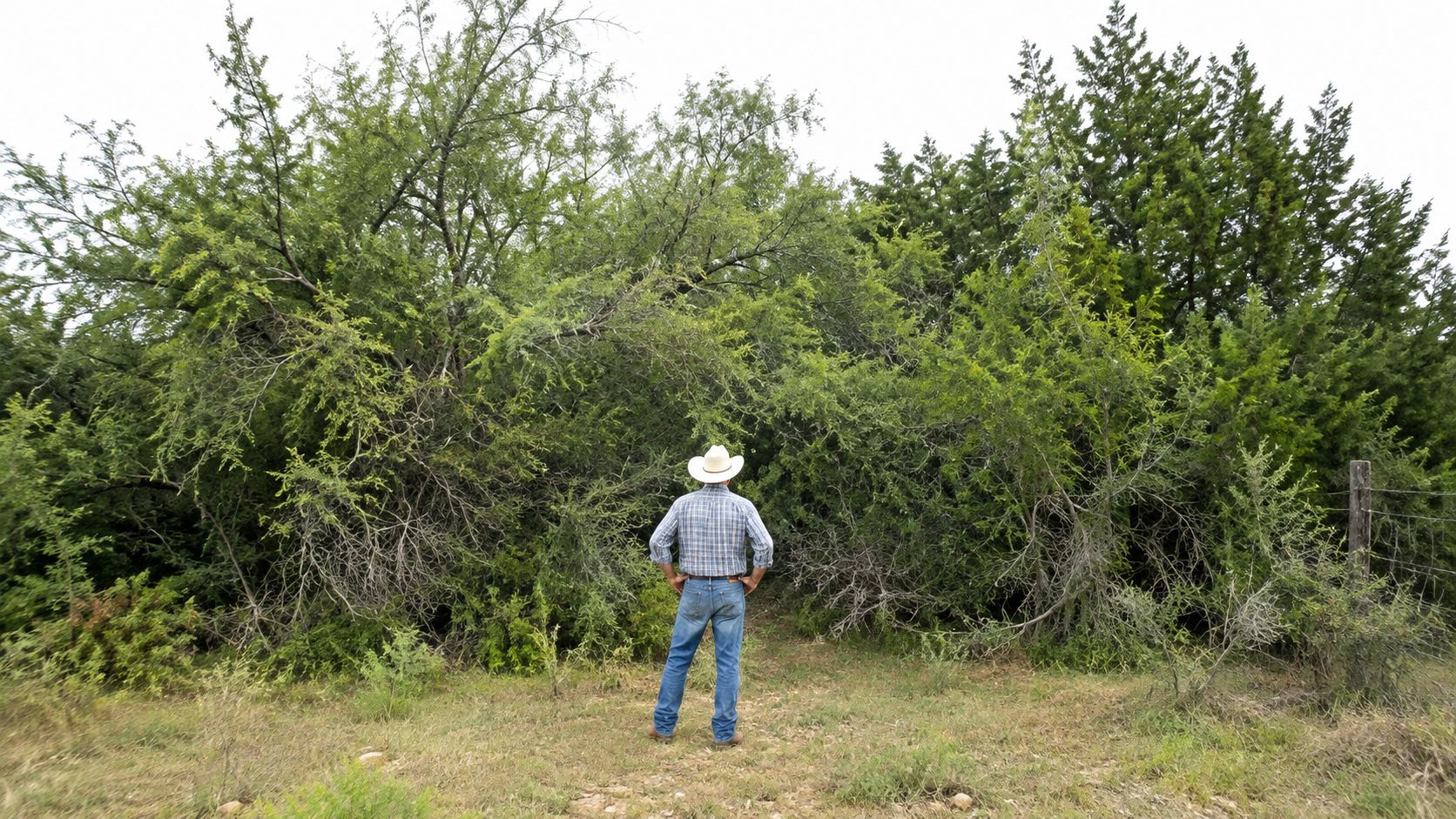
You reach the edge of the property and stop at a wall of cedar, mesquite, yaupon, and tangled vines. The old trail has disappeared, the fence line is hard to find, and the pasture you hoped to use is becoming a thicket. In the Hill Country, that problem rarely stays contained. Brush keeps advancing unless the landowner has a practical plan for clearing it and managing what grows back.
Forestry mulching in Texas can open that ground with far less soil disturbance than scraping, piling, and hauling every piece of vegetation away. But the machine pass is only the beginning. The lasting result depends on choosing the right equipment, protecting the soil, preserving worthwhile trees, and planning for resprouting species that can reclaim cleared ground.
Table of Contents
- Conquering the Texas Overgrowth
- Understanding the Scale of Brush Encroachment
- Matching the Equipment to Your Terrain
- Beyond Clearing and Soil Health and Stabilization
- The Reality of Resprouting and Long-Term Care
- Planning Your Project for Success
Conquering the Texas Overgrowth
A rancher walks toward a blocked access road expecting to find a simple maintenance job. Instead, the route ends in dense cedar and mesquite, with young trees packed beneath taller brush and enough fallen material to make walking difficult. Cutting it by hand would take far too long, while pushing everything into piles would disturb the ground and leave another disposal problem.
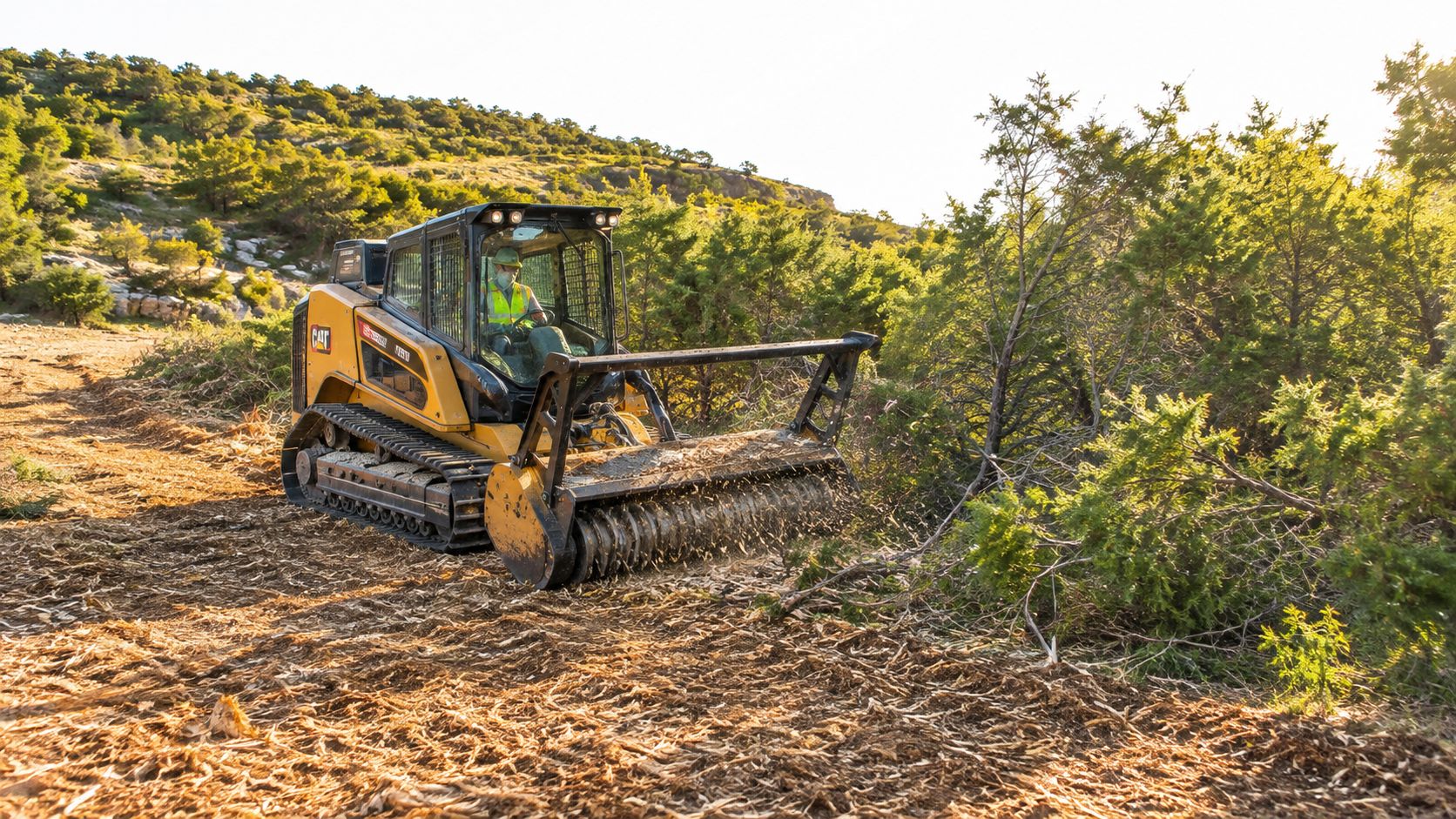
A forestry mulcher approaches the same property differently. A specialized drum mounted to a carrier cuts and grinds woody vegetation in place, reducing brush and smaller trees into organic material that remains on the soil. The operator can open a trail, clear a fence corridor, reclaim pasture, or create a homesite while working around mature oaks and other trees marked for preservation.
That difference matters on rural Texas acreage. Traditional clearing may require separate cutting, pushing, piling, burning, hauling, or grading. Mulching combines much of the surface clearing into one operation, which reduces the number of times heavy equipment needs to cross the property. It also avoids leaving large debris piles in areas where the owner wants to preserve access or keep the land visually open.
Practical rule: Clear for the way you intend to use the property, not simply for the appearance of an empty tract.
A ranch access road needs a different treatment from a future building pad. A pasture may benefit from selective removal that leaves useful shade trees, while a driveway corridor may require more precise work around drainage and utilities. The best forestry mulching projects begin with a walk-through that identifies boundaries, obstacles, desired trees, drainage paths, and the finished use of every cleared area.
The immediate result can be dramatic, but it shouldn't be mistaken for permanent vegetation control. Mulching opens the ground and improves usability. Keeping it open requires follow-up decisions based on the species removed, the soil condition, and whether the property will become pasture, a homesite, a trail system, or managed recreational land.
Understanding the Scale of Brush Encroachment
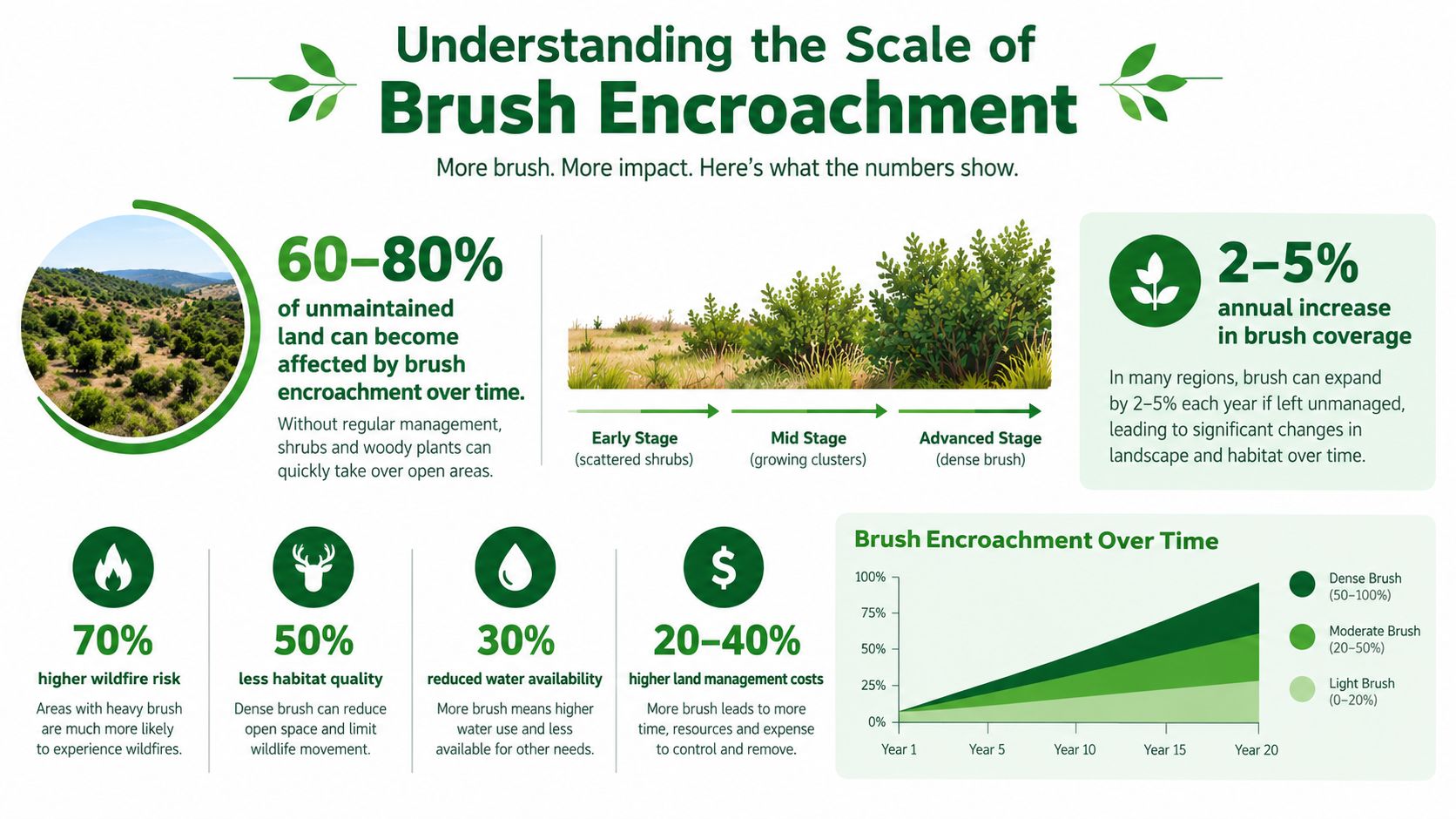
Texas landowners are dealing with a terrain condition, not a few isolated weeds. A Texas State Brush Control Plan reported that about 105 million acres of Texas rangeland were infested by brush, including more than 32 million acres classified as dense brush with 31% to 100% canopy cover. The same source recorded brush infestation across 88.5 million acres in 1963 and 92 million acres by 1973, showing that the pressure has persisted across generations of land use. These figures come from the Texas State Brush Control Plan.
The regional concentration is just as important as the statewide scale. In the Rio Grande Plains, a published study described 22 million acres of land, with 93% carrying moderate to dense brush cover, while another Texas natural resources source described roughly 21 million acres of South Texas as brush-dominated. A Texas Parks and Wildlife publication also reported that about 75 million acres, or roughly 80% of Texas rangeland, had been invaded by noxious brush and weeds, with brush using about 10 million acre-feet of water annually. Those figures are summarized in the regional brush management reference.
Why manual clearing falls short
Dense brush creates several problems at once:
- Access disappears: Trails, fence lines, gates, and maintenance routes become difficult to reach.
- Pasture competition increases: Woody plants compete with grasses for moisture, light, and growing space.
- Visibility declines: Owners lose sightlines around homesites, roads, livestock areas, and property boundaries.
- Fuel continuity grows: Cedar and other woody growth can connect ground vegetation to tree canopies, increasing concern around structures and access routes.
- Water demand rises: The Texas Parks and Wildlife figure above illustrates why brush control has practical importance beyond appearance.
A landowner can hand-cut a few trees or maintain a narrow path with a tractor attachment. That approach doesn't scale well when the property has continuous thickets across large areas. Forestry mulching is useful because it can process the woody layer without requiring every piece of material to be loaded and removed.
For cedar-heavy Central Texas properties, the decision also needs to account for what happens after the first pass. The practical differences between opening a tract, clearing a corridor, and removing cedar around valuable trees are discussed in this guide to cedar clearing on rural Texas land. The point isn't to strip every acre bare. It's to regain control of the areas that support grazing, access, fire planning, construction, or stewardship.
Matching the Equipment to Your Terrain
The carrier platform determines how a forestry mulcher behaves on the ground. The USDA Forest Service identifies skid steers, excavators, farm tractors, four-wheel-drive loaders, and dozers among the platforms used to mount mulchers in its mulcher equipment catalog. Each option changes reach, stability, maneuverability, transport needs, and the operator's ability to protect trees and work around obstacles.
Start with the ground, not the machine
A tracked excavator-mounted unit is a strong choice for rough, uneven, or sloped terrain. The boom gives the operator reach into areas that the carrier itself shouldn't enter, and the machine can work selectively around structures, mature trees, drainage features, and difficult edges. It's particularly useful when the property has steep banks, narrow access, or vegetation below a road or pad.
A skid steer offers a more compact footprint and precise maneuverability. It can be effective on accessible acreage, homesites, lanes, and smaller work areas where the operator needs to turn frequently or work close to retained trees. Tracks can improve flotation and stability, but wet or fragile ground still deserves caution.
Tractor-mounted systems suit flatter, more open land and recurring pasture or fence-line maintenance. They can make sense when access is straightforward and the job involves lighter vegetation or established routes rather than difficult extraction around large obstacles.
| Property condition | Equipment direction | Why it fits |
|---|---|---|
| Rough slopes and uneven ground | Excavator-mounted mulcher | Reach and positioning reduce the need to drive directly through every area |
| Flat, accessible acreage | Skid steer or tractor-mounted unit | Efficient movement and easier transport support open-area clearing |
| Selective work around mature trees | Skid steer or excavator | The operator can control approach angles and protect marked trees |
| Narrow corridors and difficult edges | Excavator-mounted unit | Boom reach helps address vegetation beyond the carrier's immediate path |
Match the finish to the objective
Tell the contractor whether the finished area must support walking, grazing, vehicle access, seeding, fencing, or construction. A machine that performs well for opening pasture may not provide the below-grade stump treatment required for a building footprint. Likewise, a machine selected only for speed may be poorly suited to preserving a mature oak canopy or avoiding a drainage swale.
Good equipment selection is a site decision, not a horsepower contest. The carrier should fit the terrain, vegetation, access, and level of selectivity the property needs.
Beyond Clearing and Soil Health and Stabilization
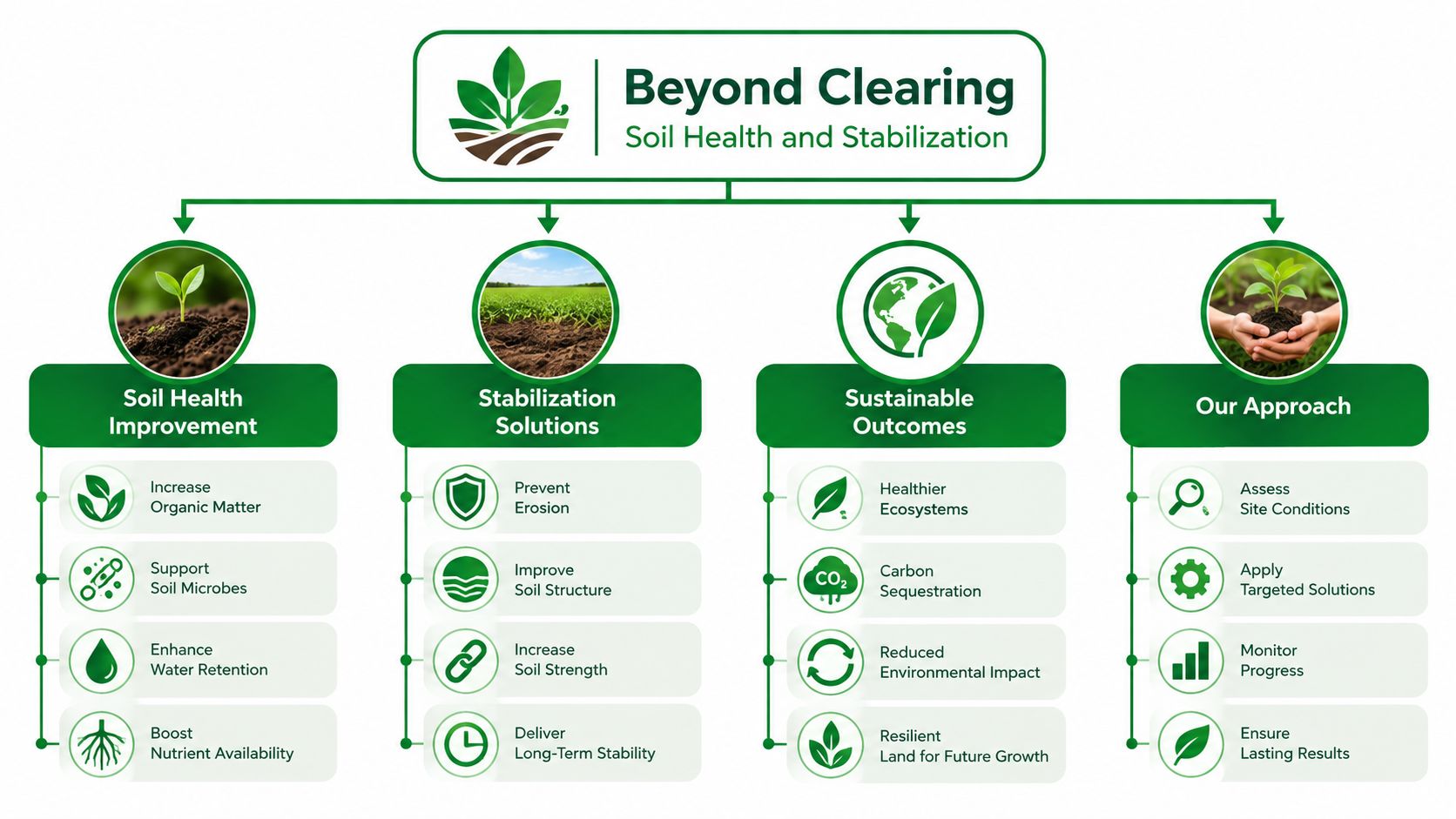
Mulching shouldn't be judged only by how quickly the property looks open. The material left on the ground can protect the soil, but only when the operator manages the pass properly. Texas A&M Forest Service recommends running mulching and shredding operations along the land contour to reduce erosion and water channeling. Its guidance also recommends a final shredding pass at a height of two to four inches, and explains that leaving shredded organic cover in place can reduce erosion potential and stabilize soil on highly erosive sites in the Texas A&M mulching guidance.
The contour matters
Running equipment straight up and down a slope can create channels that collect and accelerate runoff. Working across the contour interrupts that flow and helps keep shredded material distributed where it can absorb rainfall impact. This is especially important in Hill Country terrain, where shallow soils, exposed rock, and changing grades can turn a small disturbance into a recurring erosion problem.
Mulch also reduces the abrupt transition between dense vegetation and bare soil. It cushions rain, slows surface water, retains some moisture near the ground, and begins returning organic material as it breaks down. Those benefits don't replace drainage design, reseeding, or erosion repairs, but they give the soil more protection than leaving a scraped surface exposed.
A clean-looking tract isn't automatically a healthy tract. The finished ground should be stable, usable, and suited to what you plan to do next.
Selective clearing protects function
Removing every stem is often the wrong objective. Mature shade trees, native vegetation, wildlife cover, and established root systems can contribute to the property's character and function. Selective clearing leaves those assets in place while removing the woody growth that blocks access or competes with intended land use.
The case for mulching instead of scraping rests on that distinction. Mulching can reduce unnecessary soil disturbance, but it still requires an operator who understands where to slow down, what to preserve, and how to distribute material instead of just driving through the tract.
The visual result may be less uniform than a fully scraped site. That's usually a benefit for rural land. A property with protected canopy, stable contours, and deliberate openings tends to remain more functional than one cleared aggressively and left vulnerable to runoff.
Here's a short visual reference for how mulching fits into a lower-disturbance clearing approach:
The Reality of Resprouting and Long-Term Care
Forestry mulching is not a permanent cure for Texas brush. It removes the visible tops and processes them into mulch, but some woody plants can respond from their roots. Cedar, yaupon, chinaberry, mesquite, and other species may return if the site receives no follow-up treatment.
That doesn't make mulching a poor choice. It means the first pass should be treated as the opening phase of land management, not the final promise. A property can look transformed immediately after clearing and still develop new shoots before the owner is ready to deal with them.
Build the follow-up into the original scope
Texas A&M Forest Service notes that invasive species can resprout from roots after wildfire and may require monitoring and, in some cases, herbicide treatment. The agency also recommends selectively clearing woody vegetation over time to reduce future fire risk, as explained in its post-wildfire land management guidance.
A practical plan should answer several questions before the machine arrives:
- What species are present? Identify plants likely to resprout and separate them from mature trees or native vegetation worth retaining.
- What is the finished use? Pasture, a homesite, trails, and wildlife areas require different tolerance for regrowth.
- Will the site be monitored? Someone should inspect cleared areas after new growth becomes visible.
- Is chemical control appropriate? Herbicide may be useful for targeted resprouts, but application should match the species, location, water concerns, and land use.
- Will mechanical follow-up be needed? A later maintenance pass can keep young regrowth from becoming another dense stand.
Timing matters. Treating small, accessible regrowth is generally easier than waiting until it becomes established woody cover again. The right sequence may involve mulching first, observing what returns, applying targeted control where appropriate, and maintaining access with periodic mowing or selective clearing.
Don't confuse appearance with recovery
A cleared property isn't automatically a recovered pasture. If grazing is the goal, the land may need soil assessment, seeding, weed management, or a rest period before it can support the intended use. If construction is planned, the owner may need additional stump work, grading, drainage control, and utility coordination.
The most reliable result comes from matching the maintenance plan to the property's biology. Mulch can suppress some new growth and protect the surface, but it won't override root systems, rainfall, or the natural persistence of woody plants.
Planning Your Project for Success
Start by writing down what you want to be able to do on the land after the work is finished. “Clear the brush” is too broad. “Reopen the north access route, establish a fence corridor, preserve the live oaks near the homesite, and prepare the old pasture for management” gives a contractor something practical to assess.
Use a property-first checklist
Walk the tract before requesting a quote and mark the features that affect the work:
- Define the use areas. Separate homesites, driveways, trails, grazing areas, fence lines, recreation space, and areas that should remain untouched.
- Mark keep trees and sensitive features. Identify mature oaks, desirable native vegetation, ponds, drainage paths, wells, utilities, and structures.
- Study access and terrain. Note gates, narrow approaches, steep grades, rocky ground, soft soil, and places where a large carrier may not fit.
- Decide where mulch should remain. Mulch can help stabilize exposed ground, but construction areas, drainage features, and planting zones may require different distribution.
- Discuss stumps and finish height. Surface processing may be enough for a trail or pasture, while a building area may need separate excavation or stump removal.
- Plan the next season. Identify who will inspect for resprouting and whether reseeding, herbicide, mowing, or another clearing pass might follow.
Seasonal timing in South-Central Texas should follow ground conditions as much as the calendar. Wet ground can increase rutting and compaction, especially on clay or sloped access routes. Very dry periods can raise dust and fire concerns, while active growing conditions may make follow-up vegetation control more urgent. A contractor should evaluate the actual soil, weather, access, and intended use before committing to a work window.
A clear written scope should describe the boundaries, protected trees, equipment approach, mulch expectations, access routes, cleanup, and follow-up responsibilities. Fieldmark Land Co. describes its mulching service as part of a broader land improvement process that considers access, terrain, retained trees, and the owner's intended use.
Fieldmark Land Co. is one option for rural property owners who need forestry mulching, selective clearing, brush removal, pasture reclamation, trails, fence-line access, or ongoing maintenance around San Antonio and South-Central Texas. Visit Fieldmark Land Co. to request a property walkthrough and discuss a clearing plan that addresses both the first mulching pass and the regrowth that follows.