Is Forestry Mulching Worth It in 2026?
Is forestry mulching worth it - Wondering if forestry mulching is worth it in 2026? We break down costs, benefits, and key factors to help you decide
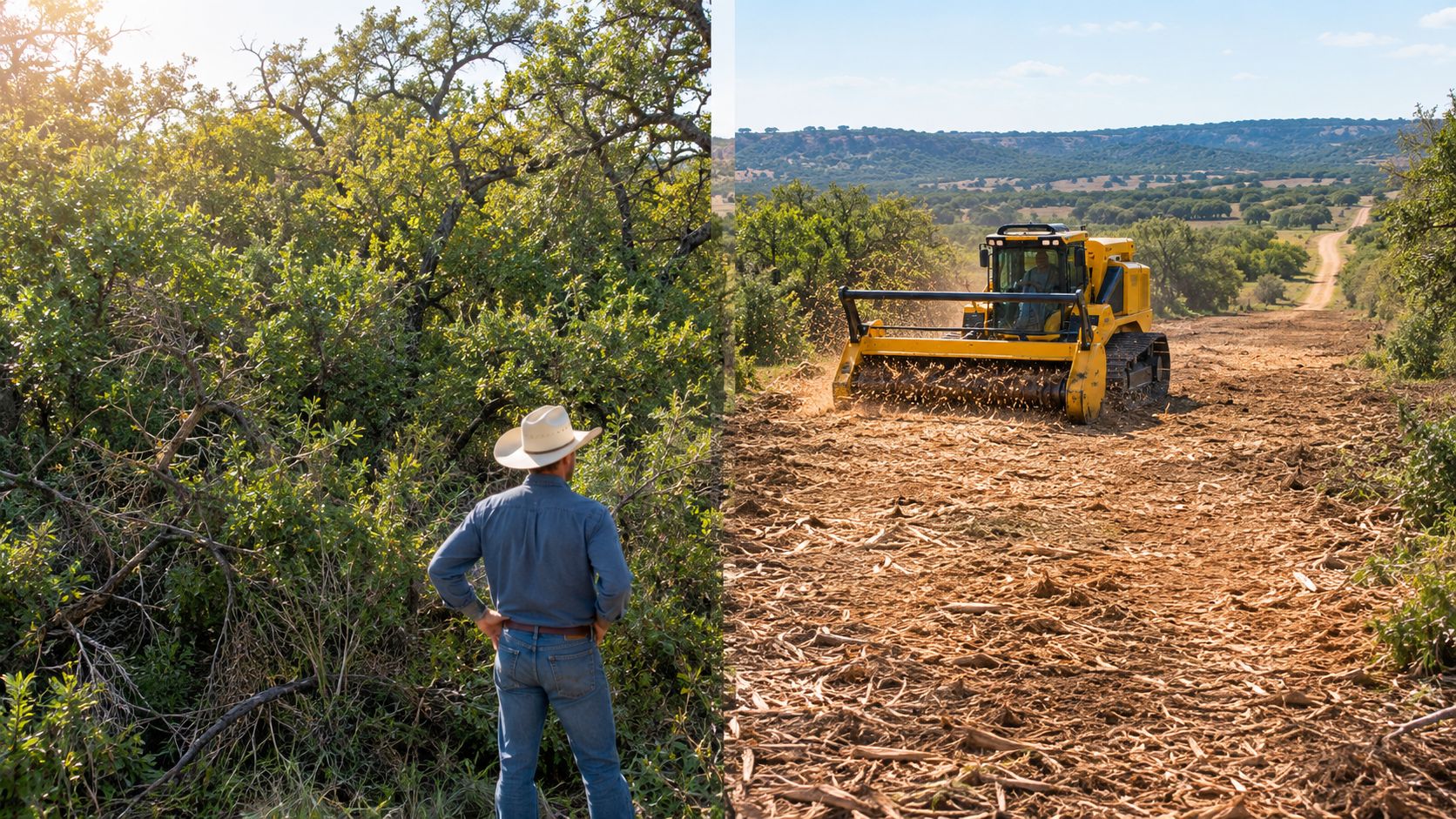
Forestry mulching is worth it when your goal is low-disturbance clearing with erosion control and immediate access, but not when you need bare-ground grading, complete root removal, or deep soil preparation for construction. The typical cost range is $1,200–$4,000 per acre depending on vegetation density.
You're probably standing at the edge of a Texas property that looked manageable when you bought it. Now cedar has closed in the old trail, mesquite is reclaiming the pasture, and the rocky ground makes every conventional clearing option look expensive. The question isn't just whether forestry mulching works. It's whether the finished condition matches what you need the land to become.
Table of Contents
- Is Forestry Mulching Worth It for Your Texas Acreage
- Understanding the True Cost Structure of Forestry Mulching
- Forestry Mulching Versus Conventional Clearing Methods
- Environmental and Long-Term Property Benefits
- Common Misconceptions About Forestry Mulching Maintenance
- Decision Framework for Texas Landowners
Is Forestry Mulching Worth It for Your Texas Acreage
A landowner in the Texas Hill Country may want three different things from one clearing project: a way through the property, better visibility around a home or fence line, and less disturbance to thin soil over limestone. Forestry mulching can handle that combination well. A tracked mulcher cuts brush and smaller trees, processes the material in place, and leaves an organic layer that helps protect exposed ground.
That makes the method a strong fit for cedar reduction, mesquite control, trail creation, selective clearing, fuel reduction, and access improvement. It also works well when mature oaks or other desirable trees need to remain standing while the understory is opened around them. The operator can shape the result around drainage, property boundaries, existing trees, and the way you plan to use the acreage.
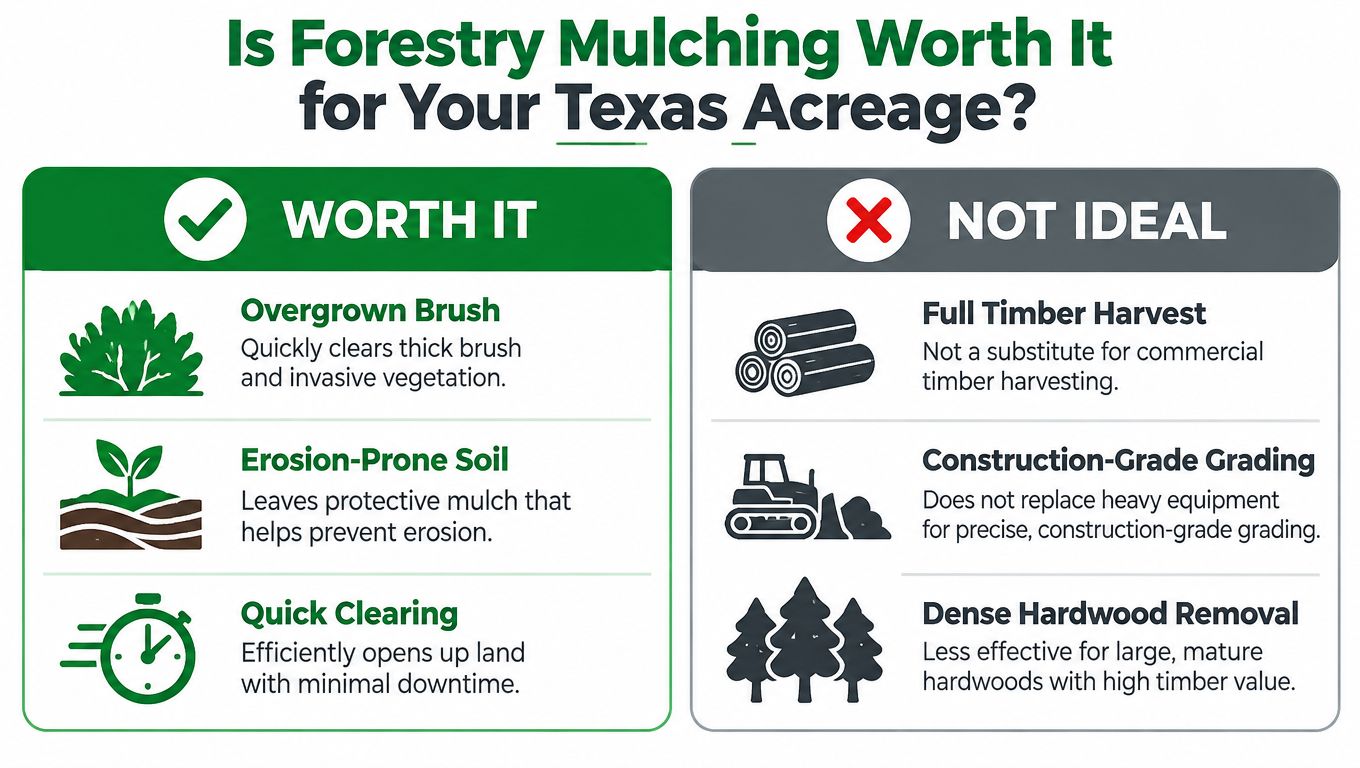
Where the method delivers value
The financial benefit usually comes from combining several tasks into one operation. Vegetation gets cut, shredded, and distributed on site instead of being loaded, transported, and disposed of separately. You get immediate access without automatically turning the entire property into a construction site.
Practical rule: If the desired finish is usable, navigable, and protected ground, mulching deserves serious consideration. If the desired finish is a level building pad, bare soil, or excavated roots, plan for a different method.
The method falls short when the property needs deep stump removal, complete root excavation, grading, or construction-ready soil preparation. A mulcher can cut a stump low, but it doesn't excavate the root ball. It can open a homesite area, but it doesn't create the final elevation or drainage profile for a foundation. On rocky Hill Country ground, it also isn't a substitute for specialized excavation where ledges, buried debris, or large obstructions control the scope.
The end state matters more than the acreage
A five-acre tract intended for hiking, wildlife access, and selective shade-tree retention may be an excellent mulching project. A smaller homesite that needs clean subgrade, utility trenches, and reliable bearing soil may require conventional clearing and earthwork instead.
That distinction prevents the most expensive mistake, paying for a process that produces the wrong finish. Forestry mulching pays for itself through access, reduced handling, erosion protection, and retained soil structure, not through the promise that every follow-up task disappears.
Understanding the True Cost Structure of Forestry Mulching
Forestry mulching prices are driven by vegetation density, stem size, terrain, access, and the required finish, not acreage alone. Current pricing references place light to medium brush commonly around $700–$2,500 per acre, while heavier conditions can reach $3,500 or more per acre. Contractor rates are also commonly reported at roughly $150–$300 per hour in 2026 pricing guidance, as summarized in this forestry mulching cost reference.
A small patch of dense mesquite can take longer per acre than a much larger field of scattered cedar and light brush. The machine slows down when the operator has to make repeated passes, work around desirable trees, maneuver around rock, or process larger stems. Poor access creates another cost layer because the contractor still has to mobilize a large machine even when the actual work area is small.
What the price actually covers
A quote generally reflects more than cutting time. It may account for equipment mobilization, loading and unloading, site access, operator time, fuel, wear on the mulching head, and the number of passes needed to achieve the agreed finish. Rocky terrain deserves particular attention in the Hill Country because exposed limestone can change both production speed and equipment risk.
The practical benchmark is whether the crew can complete the intended area in one efficient workflow. If the job requires a chainsaw crew first, separate stump work afterward, imported fill, grading, or debris removal, the initial mulching price won't represent the total project cost.
For comparison, a recent cost summary places installed forestry mulching at approximately $1,200–$4,000 per acre in 2026 and describes the method as a cost-effective single-pass option because it can avoid an additional $500–$1,500 per acre in debris-hauling costs. Those figures come from the land-clearing cost calculator and pricing summary.
A useful quoting conversation
Don't ask only, “What do you charge per acre?” Give the contractor the information that determines production:
- Vegetation: Identify cedar, mesquite, yaupon, volunteer hardwoods, vines, and any unusually large trees.
- Terrain: Point out slopes, draws, exposed rock, wet areas, and places where runoff concentrates.
- Access: Explain gate widths, overhead lines, fences, septic features, wells, and the route from the road to the work area.
- Finished use: Say whether you want trails, pasture, a fence corridor, a homesite, a view corridor, or general reclamation.
- Keep areas: Mark mature trees, habitat features, drainage features, and any vegetation that should remain.
Landowners comparing options can also review this guide to brush removal prices, but a site-specific walkthrough remains more useful than a broad per-acre estimate. The same acreage can produce very different invoices when one tract is open and accessible while another is dense, rocky, and difficult to reach.
Forestry Mulching Versus Conventional Clearing Methods
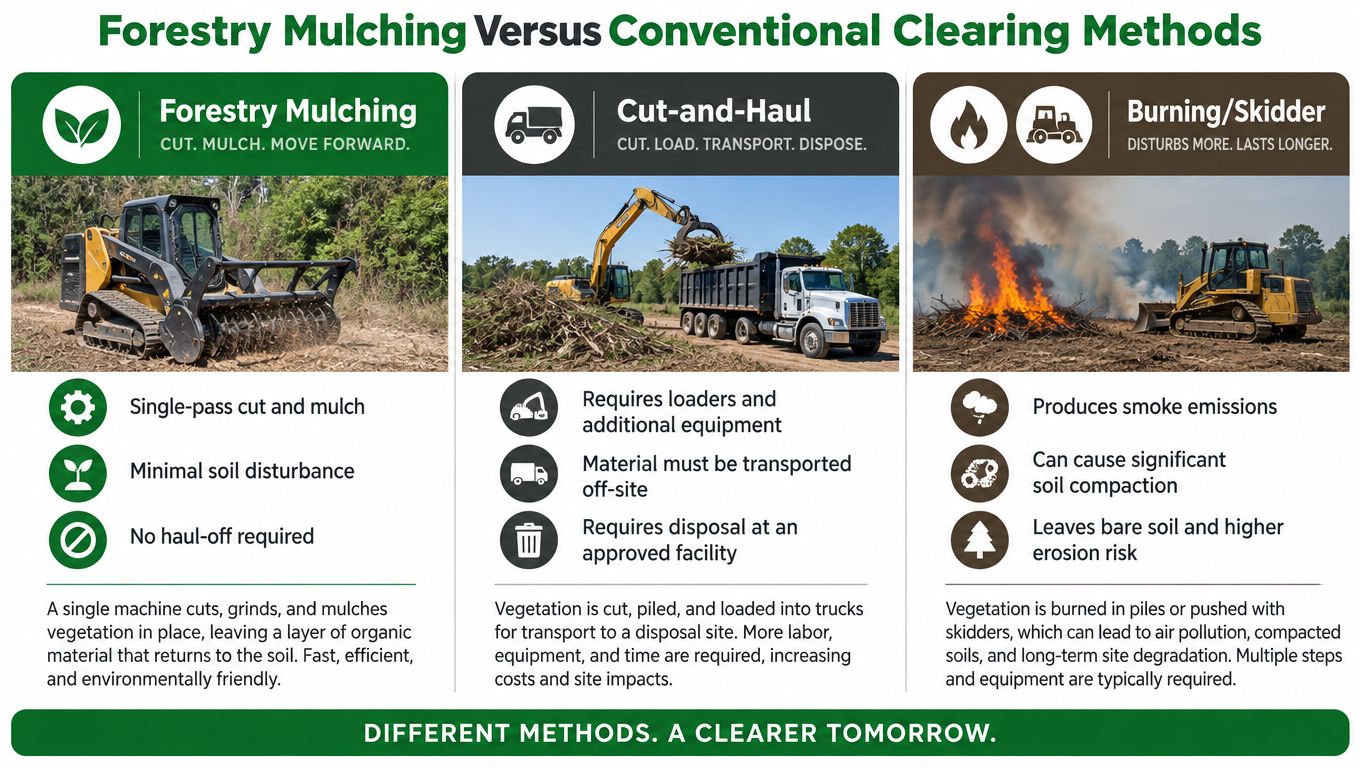
Forestry mulching and conventional clearing solve different problems. Mulching cuts and processes vegetation where it stands. Cut-and-haul clearing separates the work into more stages, often involving felling, loading, trucking, disposal, and additional cleanup. Skidders and bulldozers can move substantial material, while burning can reduce piles where regulations and conditions allow, but each option changes the soil and site-management equation.
The single-pass workflow is the main reason mulching can compete financially even when the hourly equipment rate appears high. The brush becomes ground cover instead of a waste stream. Conventional clearing may still be the correct choice where a builder needs stumps removed, roots excavated, and the surface graded to a specified elevation.
How the methods differ
| Method | Main strength | Main limitation |
|---|---|---|
| Forestry mulching | Processes woody vegetation on site with limited soil disturbance | Leaves roots and some stumps in place |
| Cut-and-haul | Removes vegetation and debris from the property | Requires handling, transport, and disposal planning |
| Skidder or bulldozer work | Moves heavy material and can support comprehensive clearing | Can disturb soil and require follow-up grading |
| Burning | Reduces accumulated piles where permitted and safe | Requires suitable conditions, planning, and smoke management |
The soil-protection difference matters on sloped Central Texas acreage. A U.S. Forest Service study of overland skid-trail best management practices found that mulch-treated areas averaged 1.47 tons of erosion per acre per year, compared with 10.8 tons per acre per year for untreated controls, an 86% reduction. The findings are documented in this U.S. Forest Service erosion-control study.
Why Texas terrain changes the calculation
On rolling Hill Country land, every extra equipment pass can create more opportunity for rutting, compaction, and runoff concentration. Leaving the mulch layer in place can protect disturbed spots while roots continue anchoring the soil. That doesn't mean mulching eliminates erosion planning. Water still follows slope, and concentrated flow may require drainage work, seeding, or other controls.
Cut-and-haul remains more appropriate for a foundation footprint, driveway section, septic area, or utility corridor that needs a clean, inspectable subgrade. A hybrid plan often makes sense: use full clearing only where construction requires it, then mulch the surrounding acreage to improve access and reduce unnecessary disturbance.
A landowner considering the alternatives should compare the complete workflow, not just the machine rate. The relevant questions include whether material leaves the site, who handles disposal, what happens to the topsoil, and whether the finished ground is ready for the next use. More detail on the operational distinction appears in this guide to brush clearing methods.
Environmental and Long-Term Property Benefits
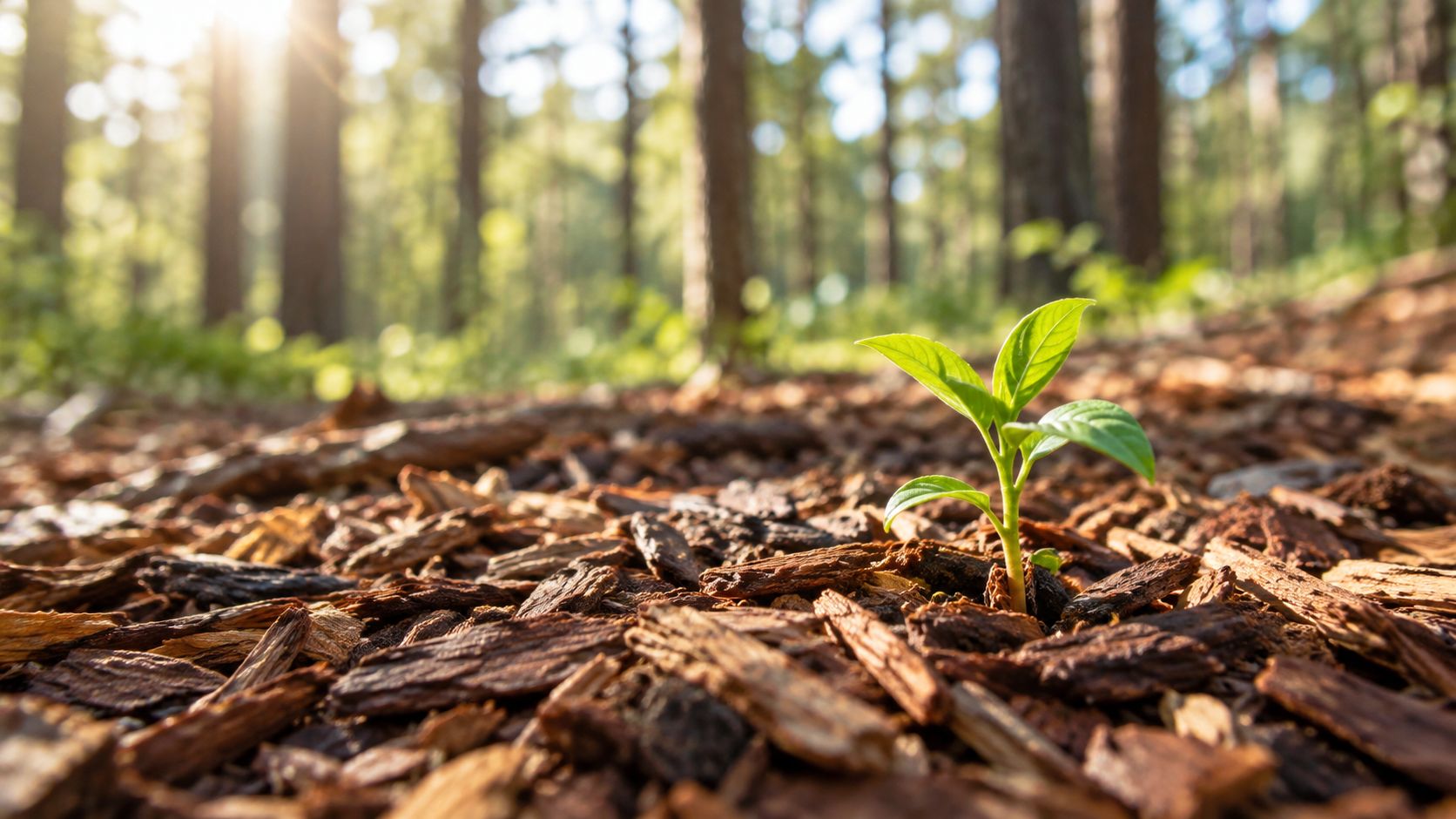
Mulch left on site changes the project from simple vegetation removal into a form of land treatment. Organic material can return nutrients as it breaks down, help retain moisture, and reduce swings in soil temperature. Those qualities matter in Texas, where intense heat and dry periods can stress exposed ground and newly established vegetation.
The benefit is strongest when the operator applies material evenly rather than creating deep piles. Guidance from the U.S. Department of Agriculture indicates that roughly 60%–70% ground cover is typically most effective for limiting erosion and sedimentation, according to the Forest Service research briefing on mulch treatment.
Preserving the land beneath the brush
A mulcher can open the property without automatically stripping the soil profile. Roots from retained trees and remaining vegetation continue to hold ground in place, while the surface layer helps shield soil from direct rainfall and heat. For a ranch, recreational tract, or future homestead, that retained structure may be more valuable than a perfectly bare appearance.
Texas A&M Forest Service describes on-site organic mulch as a material that can reincorporate nutrients, improve moisture retention, and moderate soil-temperature changes in land-management settings. Its mulching and shredding guidance also supports viewing the practice as stewardship when the treatment matches the land-use goal.
Operational studies found very few negative vegetation effects five years after treatment, while post-fire hillslope research associated moderate mulch cover with better plant cover and seedling density. Excessively heavy application can suppress recovery, so the operator's finish matters as much as the decision to mulch.
Stewardship is not the same as conversion
Selective clearing can improve pasture access, reopen trails, protect views, and reduce hazardous fuel while leaving a functioning area behind. It isn't the same as converting every acre to bare ground. Owners who want mature oaks, wildlife cover, natural drainage, and future regeneration usually gain more from a controlled treatment than from indiscriminate removal.
The distinction also affects resale and long-term usability. A property that is easier to inspect, traverse, fence, and maintain can serve more purposes without losing its rural character. A bare, compacted site may be easier to grade in the short term but more demanding to restore.
Before work begins, walk the site and identify trees to keep, drainage paths, sensitive areas, and the parts that need a different treatment. That planning is what turns mulching from broad vegetation removal into a deliberate property-improvement decision.
Common Misconceptions About Forestry Mulching Maintenance
A mulched tract can look complete the afternoon the machine leaves. In the Texas Hill Country, that clean appearance is a starting point, not proof that the brush problem is solved. Cedar, mesquite, yaupon, and other woody plants may continue responding to the disturbance through resprouting or new growth.
Mulch can decompose over 6–18 months, and the process may temporarily tie up nitrogen or leave too much material for immediate seeding. The material, depth, weather, and intended land use all affect the result. This comparison of tree removal and forestry mulching explains how mulching differs from conventional removal. On rocky ground, the operator's finish also affects whether the surface is ready for access, pasture work, or construction follow-up.
What returns after the first pass
Cut cedar and mesquite can resprout from the base or root system. Aggressive woody growth can reclaim an opening if the owner treats cleanup mulching as a permanent land-use change. It is better to schedule follow-up around the property's purpose.
A practical maintenance plan may include:
- Mowing: Use it where terrain and access allow equipment to revisit young growth.
- Herbicide treatment: Target resprouting species where responsible application fits the plan.
- Spot mulching: Treat isolated regrowth without repeating a full-acreage pass.
- Seeding preparation: Move excess mulch or let the surface settle before establishing grass or other cover.
- Routine inspection: Check fence lines, trails, homesite edges, and drainage routes on schedules suited to each use.
For Hill Country cedar and mesquite regrowth, plan a spot-mulch or mowing pass at 9–12 months, then inspect fence lines quarterly. A recreational tract may need only periodic access work. Pasture reclamation requires a deliberate plan for grass establishment and woody regrowth, while a homesite may need grading and construction work soon after vegetation removal.
A clean appearance can hide unfinished work
Mulching does not remove buried metal, old fencing, concrete, large rocks, or deep roots. It also does not correct drainage problems or establish a final grade. Include those limitations in the work scope before equipment arrives, especially on rocky Texas acreage.
The first pass creates opportunity. Maintenance protects it.
Budget for the next action while planning the first. If the land will be seeded, fenced, grazed, built on, or marketed for sale, define the required finish in those terms rather than treating “cleared” as a complete specification. A structured property maintenance plan can keep trails open, control resprouting cedar and mesquite, and preserve access after the initial mulching pass.
Decision Framework for Texas Landowners
The fastest way to answer “is forestry mulching worth it” is to define the finish before comparing contractors. Start with the land-use question, then work backward to the treatment that supports it.
1. Define the destination
Choose the outcome that best describes the project:
- Pasture reclamation: Mulching may open woody encroachment, but follow-up work is likely if grass establishment is part of the plan.
- Trails and access: In-place processing is often a sensible fit because the goal is a navigable corridor, not bare ground everywhere.
- Recreation and stewardship: Selective clearing can improve sightlines and movement while retaining mature trees and natural character.
- Homesite or barn area: Mulching may handle the surrounding acreage, while the building footprint may need conventional clearing, grading, and root removal.
- Fence-line work: A narrow, defined corridor can be treated differently from the rest of the property.
2. Assess the site honestly
Walk the area and record the factors that will affect production and the finished result:
- Vegetation: Is the growth mostly cedar, mesquite, brush, saplings, or larger timber?
- Terrain: Will slopes, draws, loose rock, or ledges limit machine movement?
- Access: Can the equipment reach the work zone without crossing sensitive areas or risking utilities?
- Soil protection: Is retaining cover important because runoff could concentrate on a slope?
- End condition: Can you accept mulch and remaining roots, or do you need exposed, graded soil?
Aerial imagery helps with acreage, but it won't reveal every gate, rock shelf, fence remnant, drainage feature, or desirable tree. A site walkthrough is where the true scope gets defined.
3. Match the treatment to the risk
Choose forestry mulching when low disturbance, immediate access, selective clearing, and on-site residue management are central to the project. Consider conventional clearing when the work requires excavation, full debris removal, deep stump removal, or construction-grade grading.
On a larger property, the answer doesn't have to be uniform. Treat the homesite, driveway, septic area, and utility corridors according to their engineering needs. Use selective mulching on the surrounding acreage where retaining soil cover and mature vegetation provides more value.
4. Put maintenance in the budget
Ask who will inspect regrowth, manage seeding, maintain trails, and revisit fence lines. A realistic plan protects the initial investment better than a promise that the land will never need attention again.
For San Antonio and surrounding Hill Country properties, Fieldmark Land Co. offers forestry mulching, selective clearing, brush removal, access improvements, pasture reclamation, and ongoing property maintenance, with project scopes shaped around the owner's intended use.
If your acreage is crowded with cedar, mesquite, or unmanaged brush, Fieldmark Land Co. can walk the property, identify what should stay, and match the clearing method to your next use. Visit Fieldmark Land Co. to request a practical evaluation for access, selective clearing, pasture reclamation, or a defined homesite project.