Forestry Mulching Services Explained for Texas Landowners
Learn how forestry mulching services work, what they cost, and when they fit your property. A practical guide for San Antonio and Hill Country landowners.
You pull through the gate and the property looks smaller than it did on the survey. Cedar closes the view from the road. Mesquite saplings crowd the old pasture. Huisache has elbowed into the fence line, and dead brush from the last drought catches at your boots. Somewhere under that growth are the oak trees you want to keep, the route for a future driveway, and a slope that sends stormwater toward the creek.
That's the forestry mulching decision on a Hill Country property. It isn't whether a machine can remove brush. It's what stays, what goes, and what the ground should look like after the first growing season. Forestry mulching services can open access, improve visibility, and retain topsoil, but they don't automatically create a building pad, eliminate root systems, or prevent every plant from returning.
Table of Contents
- What Forestry Mulching Actually Does on a Property
- How the Mulching Process Works from Start to Finish
- Where Forestry Mulching Fits Best on Rural Acreage
- Environmental and Aesthetic Outcomes on the Ground
- What Drives the Cost of a Mulching Project
- What Forestry Mulching Cannot Fix on Its Own
- Working with a Mulching Service in the Hill Country
- Deciding Whether Forestry Mulching Is Right for Your Land
What Forestry Mulching Actually Does on a Property
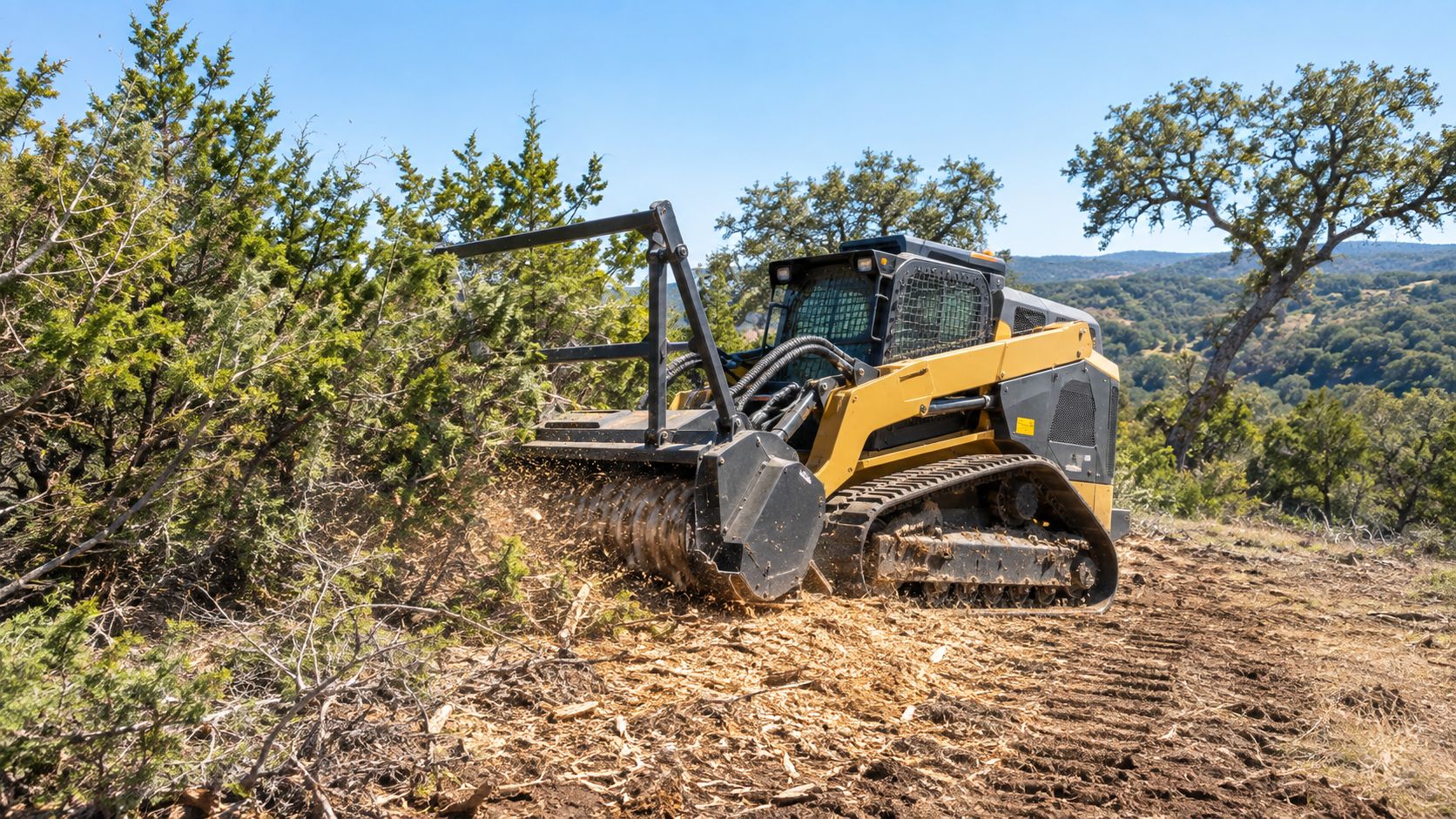
A forestry mulcher processes standing vegetation where it grows. A tracked carrier or purpose-built machine carries a rotary drum or disc head that cuts brush and smaller trees, then grinds the material into woody chips that remain on the soil surface. Instead of pushing everything into a pile, loading it into trucks, or burning it, the operator spreads the processed material across the area being cleared.
That changes the property immediately. A closed-in trail becomes passable. A hidden fence line becomes visible. Brush that once forced you to walk sideways through the pasture becomes a low, rough layer of mulch underfoot.
What remains after the pass
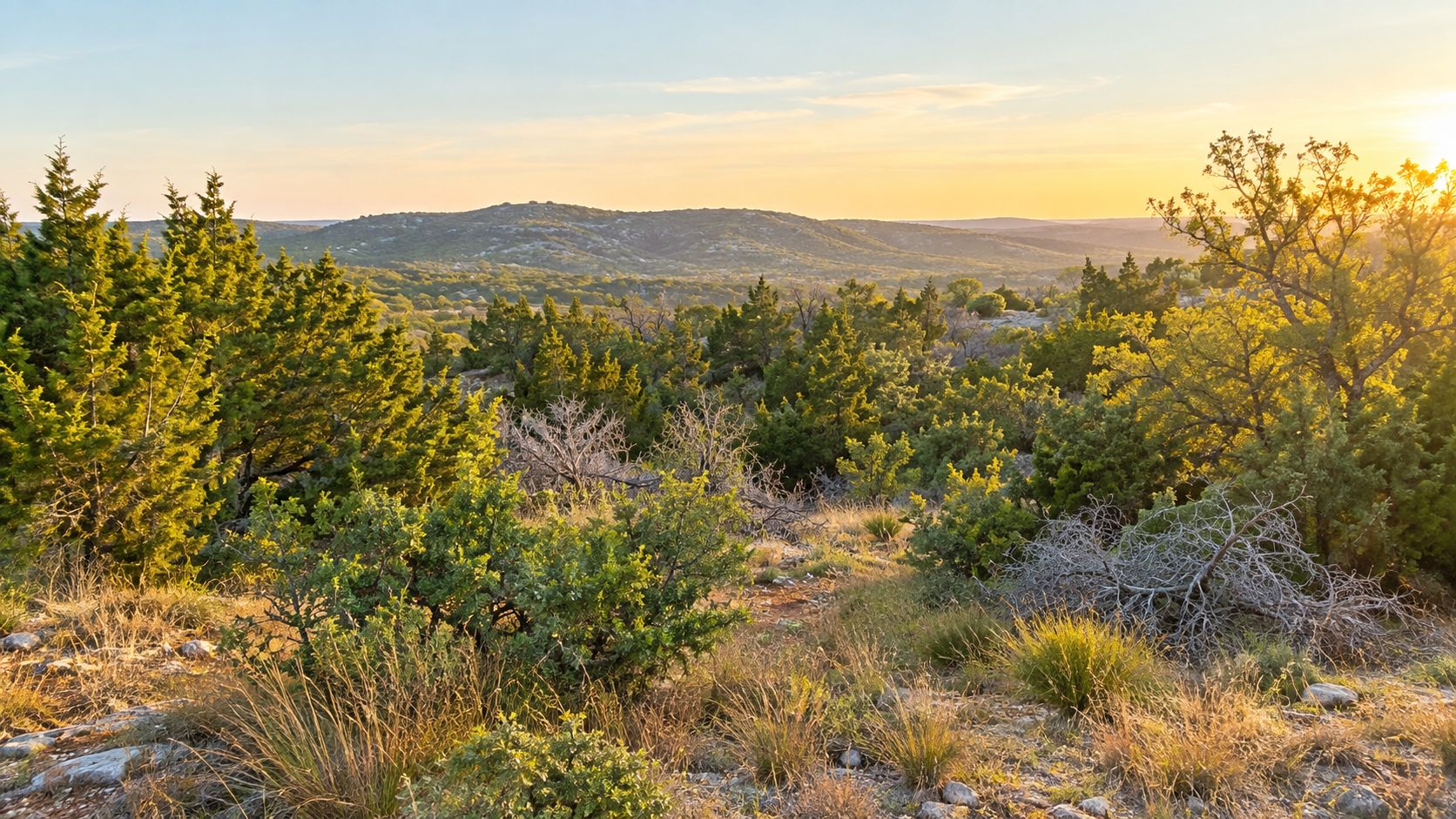
Selective work starts with deciding what the operator must avoid. Mature live oaks, useful shade trees, healthy native trees, survey markers, utility features, gates, and sensitive drainage areas should be identified before the machine enters the tract. The topsoil, existing terrain shape, and below-ground root systems generally remain in place because mulching cuts and processes vegetation at or near the surface rather than excavating the ground.
That distinction matters on rocky Hill Country acreage. A mulcher can work around exposed limestone, but it doesn't remove the rock. It also won't turn uneven ground into a level homesite. You're retaining the landform, not replacing it.
What the machine removes
The target is usually the woody layer that makes the property difficult to use:
- Cedar and scrub regrowth: Smaller trees can be processed while selected mature trees remain.
- Mesquite and huisache seedlings: Young, dense growth can be knocked back, though root systems may support later resprouting.
- Shin oak thickets and dead brush: The machine can open tangled understory without creating a separate brush pile.
- Small saplings and woody encroachment: Material must still fall within the carrier and head's safe operating capacity.
A forestry mulcher isn't a universal tree-eating machine. Stem diameter, species, density, slope, rocks, and access determine what can be handled efficiently. Ask an operator to assess the largest trees in the work area rather than relying on a generic equipment claim.
Practical rule: A mulched property is cleared at the surface, not reset to a blank slate underground.
The visual change can be dramatic on the day the machine leaves, but the soil chemistry, dormant roots, and seed bank underneath haven't been rewritten. That's why a successful first pass should be judged against the intended use and future maintenance plan, not only by how open the acreage looks from the driveway.
How the Mulching Process Works from Start to Finish
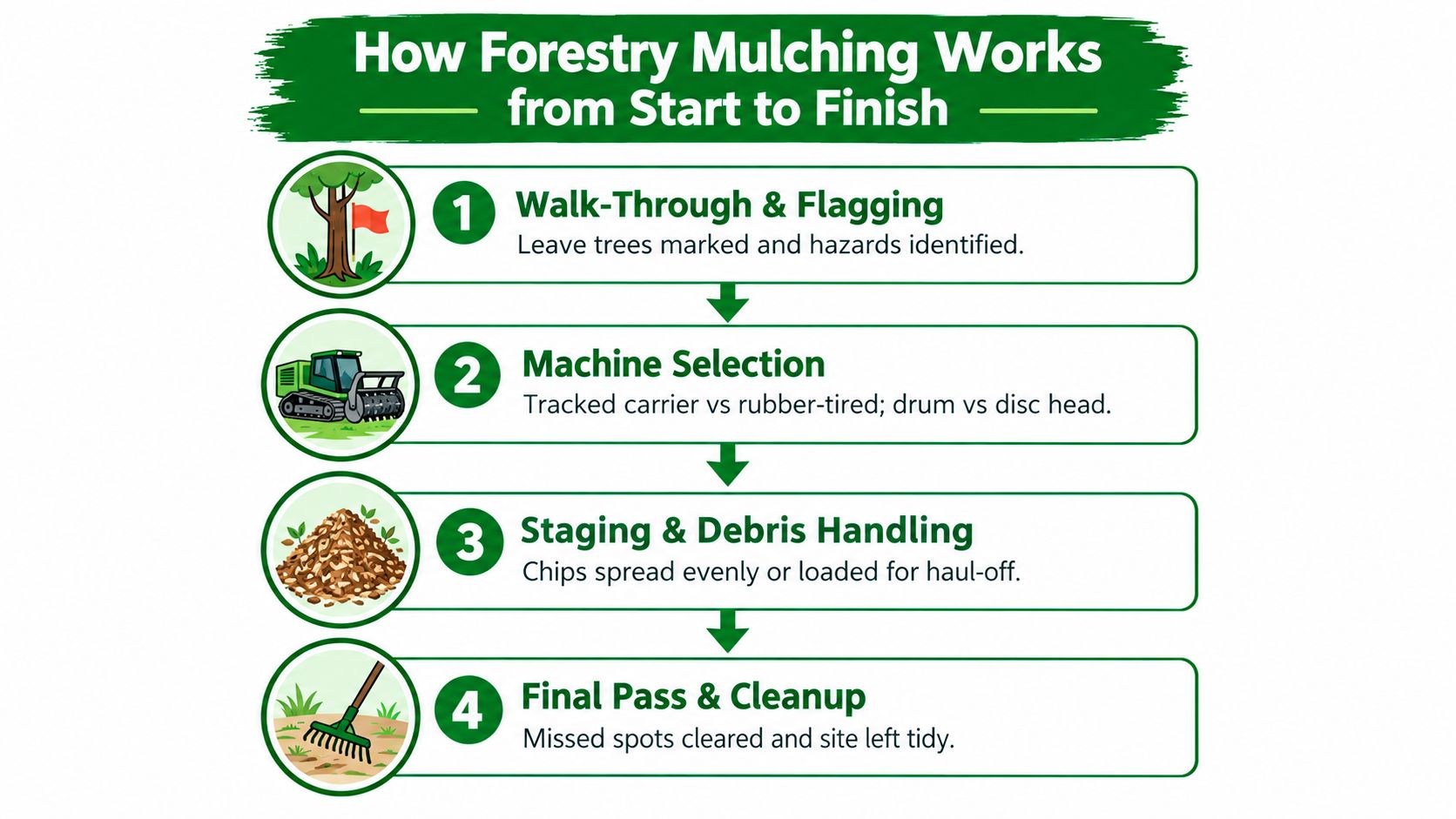
A successful job starts with a walk of the property, not with the machine. The operator and owner should agree on work limits, mark trees that stay, and locate wire, old metal, buried debris, steep drop-offs, wet ground, and utility lines. Boundaries and entry routes matter just as much as the brush. A clean corridor cut in the wrong place is still a failed result.
The equipment choice follows the ground
A tracked carrier or compact track loader generally gives the operator a stable platform on rough Hill Country terrain. A rubber-tired machine can move efficiently across firmer, more open ground. The cutting head affects the result as well. Drum heads can produce fine, consistent mulch in suitable vegetation, while disc-style heads may suit different material and production demands.
Before setting a price or promising a finish, the operator needs to assess the debris load. U.S. Forest Service equipment data records debris loads of 26 to 61 tons per acre and a rotary head masticator average of 0.57 acres per hour, with a range from 0.21 to 0.89 acres per hour. Those benchmarks explain why a thin cedar edge and a dense, drought-killed thicket should not receive the same production assumption. The U.S. Forest Service mulcher equipment data provides the underlying equipment benchmark.
What the operator does during the pass
The cutter head works close to the ground as the machine advances through the brush. The operator may pause around a larger trunk, feather the head beside a retained oak, or approach a utility line from a safer direction. Slopes and exposed rock slow the work because traction, visibility, and head contact affect both safety and finish quality.
Conventional clearing can require felling, dozing, root raking, piling, burning, hauling, and grading. Mulching handles the vegetation-processing stage in one operation and leaves the biomass on site. That removes the haul-off step, while leaving the owner with a rough, organic surface rather than bare, graded soil.
The final pass catches missed brush, thick patches, and uneven distribution. Where conditions allow, the chips should be spread as an even carpet instead of tall windrows that restrict drainage or future mowing. Rocky ground will remain irregular. A year later, the property should reflect the intended use and maintenance plan, not just the machine's path. The practical finish is accessible, deliberately cleared ground, not a finished lawn.
Where Forestry Mulching Fits Best on Rural Acreage
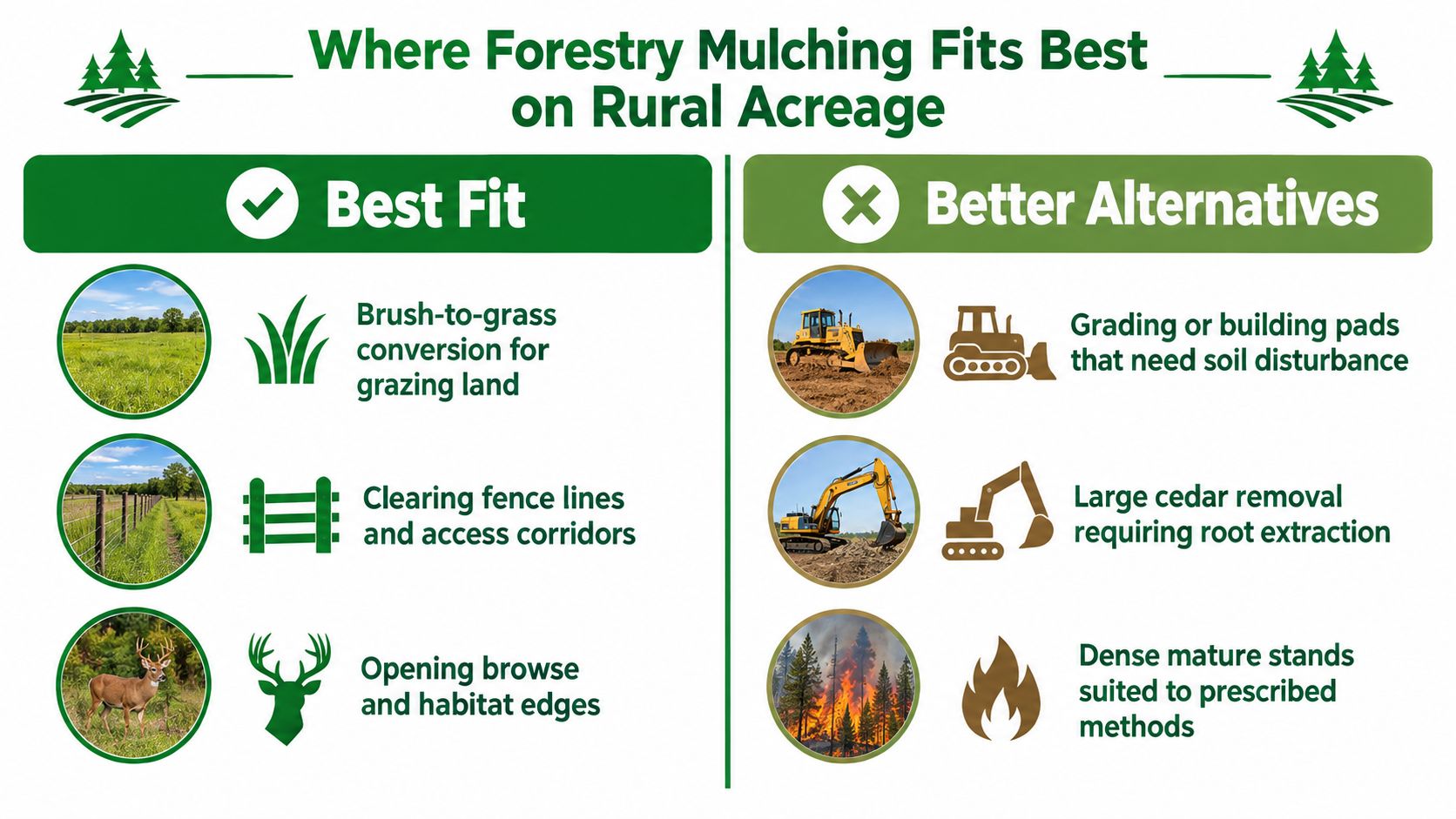
Forestry mulching earns its place when the goal is to open land without unnecessarily disturbing the soil. It's particularly useful where the owner wants access, visibility, pasture recovery, habitat edges, or a defined corridor, while mature trees and the existing grade remain part of the property.
Strong fits for a mulcher
Pasture reclamation is a common example. If woody growth has taken over former grazing ground, mulching can remove the above-ground brush while leaving topsoil and much of the terrain intact. The result still needs a plan for grass establishment, grazing, mowing, herbicide, or fire, but the first barrier to using the pasture is gone.
Fence lines, water-line corridors, driveway approaches, and ranch access trails also suit the method. These projects usually benefit from selective width and clear visibility rather than wholesale clearing. The operator can leave shade trees and habitat features while opening enough room for inspection, construction, livestock movement, or maintenance.
Wildlife management can require a more deliberate pattern. Opening browse edges, creating travel routes, and breaking up dense stands may be more useful than clearing every stem. The right scope leaves a mosaic of cover and openings instead of producing a uniform, exposed tract.
When another machine belongs on the job
A homesite illustrates the boundary. Mulching can clear vegetation from the broader homesite area, but a foundation footprint may require stump excavation, root removal, soil preparation, and grading. An excavator and dozer are better suited to those structural tasks.
Use a different method when the outcome demands:
- A precise building pad: Grading and compaction require soil to be moved and shaped.
- Large stump or root-ball removal: Mulching processes the top but doesn't excavate the root system.
- A bare, smooth agricultural finish: Row-crop preparation may call for disking, grading, or other soil-working equipment.
- Removal of large mature trees: Felling, logging, or excavating may be safer and more appropriate.
- Complete debris export: If no woody material can remain on site, hauling must be part of the scope.
A combined approach often makes more sense than forcing one machine to handle every condition. Mulch the access corridors and brushy acreage, then bring in excavation or grading equipment only where the future use demands it.
Environmental and Aesthetic Outcomes on the Ground
The first visual result is not a manicured field. It's an open, rough surface with shredded woody material, low stumps, root crowns, and occasional larger pieces. Mature hardwoods that were marked for retention remain standing, while cedar, mesquite, huisache, and dead brush disappear from the sightline.
The mulch layer can protect disturbed ground because it intercepts raindrop impact and slows water moving over the surface. A review of mulched forest-road and post-disturbance surfaces found that mulch cover significantly reduced surface runoff and sediment yield. A U.S. Forest Service review identifies roughly 60% to 70% ground cover as an effective target for wood mulch, with a commonly used application depth of about 2 to 3 inches. Those figures come from independent erosion and mulch-cover research, and they're useful benchmarks, not a promise that every Hill Country slope will respond identically.
What changes over the first year
A thick or uneven mat can slow light reaching the soil surface, but it won't permanently suppress every plant. Some species resprout from roots or crowns. Others return from seed after rain and warmer weather. The speed and pattern depend on vegetation, moisture, sunlight, soil, and whether the owner follows with mowing, herbicide, grazing, or fire.
| Metric | Before Mulching | 1 Month After | 6 Months After | 12 Months After |
|---|---|---|---|---|
| Visibility | Blocked by dense woody growth | Open sightlines in treated areas | Regrowth may appear at edges and from surviving roots | Long-term openness depends on follow-up treatment |
| Ground cover | Leaf litter, bare patches, and standing brush | Woody mulch covers much of the treated surface | Mulch begins breaking down and settling | Surface becomes more integrated with the soil and new vegetation |
| Erosion exposure | Soil may be exposed beneath or between brush | Mulch cushions raindrop impact and slows runoff | Storms and traffic reveal weak spots | Stabilization depends on cover, slope, and maintenance |
| Access | Walking, driving, or fencing may be obstructed | Routes become usable, though rough | Maintenance access determines whether openings persist | Intended use may require mowing, grading, or another pass |
| Vegetation response | Mature trees, saplings, and brush compete for space | Selected trees remain, unwanted stems are cut | Resprouts and seedlings become easier to identify | The property shows whether the original scope matched the long-term goal |
Mulching improves the surface condition when the operator distributes the material evenly and avoids unnecessary soil disturbance. It doesn't guarantee improved water availability or eliminate drought stress. Texas rangeland research describes brush-removal water benefits as limited and site-specific, so landowners should treat access, visibility, and vegetation structure as the primary predictable outcomes rather than assuming broad hydrologic recovery. The Texas brush-management research supports that more cautious expectation.
What Drives the Cost of a Mulching Project
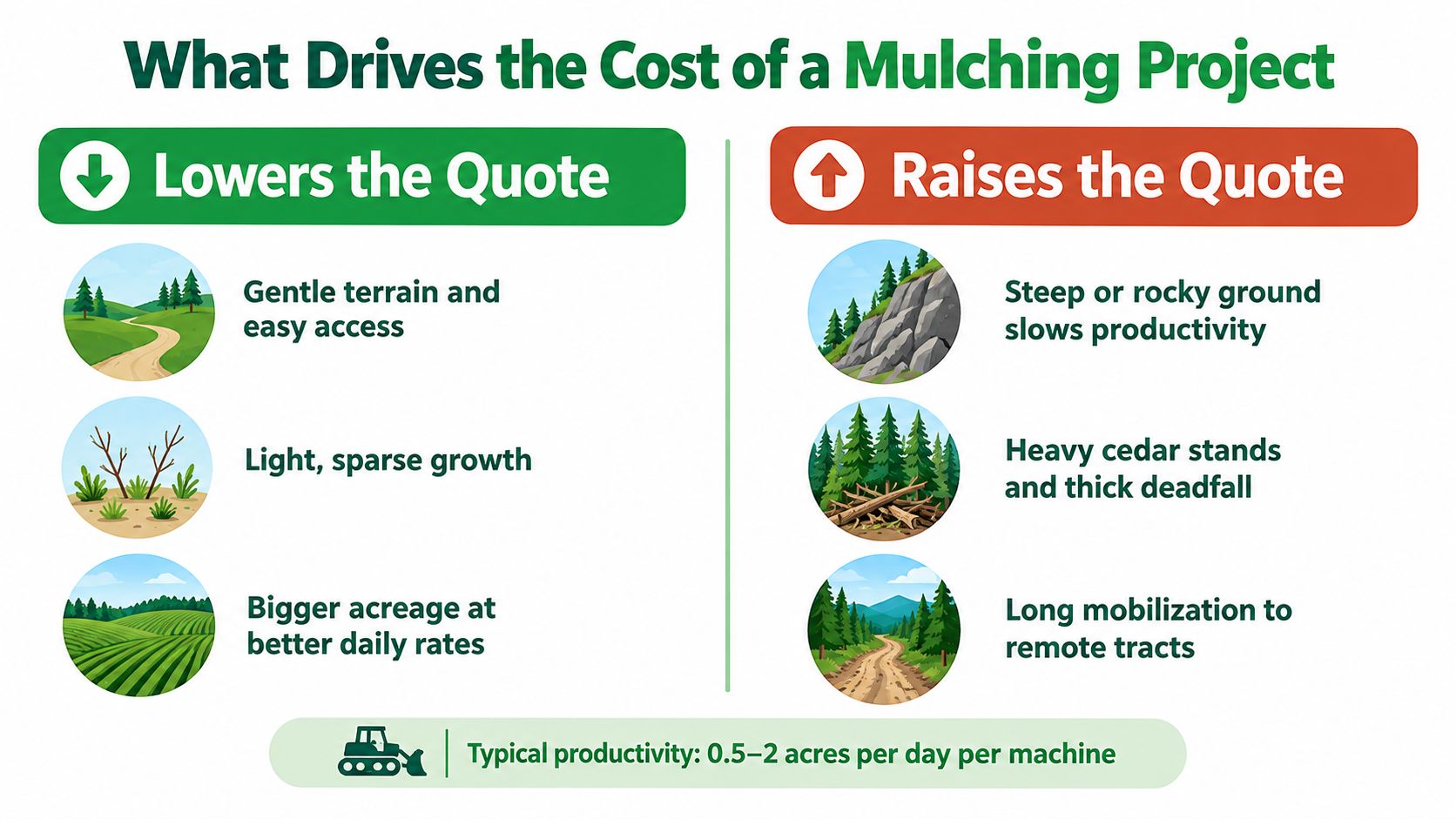
A flat per-acre promise can hide the work that determines the final bill. Two Hill Country tracts with the same acreage may require very different machine time. One might have scattered young brush on gentle ground. The other may contain dense cedar, deadfall, exposed limestone, steep slopes, or a gate too narrow for easy equipment access.
The main cost drivers are material density, stem size, terrain, access, and mobilization. A contractor spends more time when the head must process heavy woody growth, work around rocks, protect retained trees, or make repeated passes through difficult pockets. Published equipment benchmarks can help frame production assumptions, but they do not replace a site-specific quote.
The variables behind the number
- Light growth: Sparse brush and clear access allow faster production.
- Heavy growth: Dense cedar, tangled huisache, and dead material make the operator process more biomass in the same area.
- Rock and slope: Exposed limestone and steep ground require slower, safer approaches.
- Access and staging: Narrow gates, long travel from the road, and poor loading areas add setup and travel time.
- Scope and finish: A single knockdown pass costs less than selective trimming, repeated treatment, or detailed cleanup.
The lowest bid may describe a smaller job rather than offer better value. One contractor may price a quick reduction of standing brush, while another includes flagging, selective tree retention, fence-line cleanup, and a second pass through dense areas. Those choices affect what the property looks like after the first growing season and how much follow-up remains.
Before comparing totals, ask which stem sizes are included, how low the operator will cut, whether rocks and debris are excluded, how retained trees will be protected, and whether mobilization is included. Confirm whether the finished acreage is intended for rough access, a cleaner appearance, or preparation for separate grading or construction work.
For more context, review Fieldmark's brush removal pricing guide. The useful question is not only, “What is the price per acre?” Ask what condition the land will be in when the crew leaves, what vegetation will remain, and which tasks will still be needed afterward.
What Forestry Mulching Cannot Fix on Its Own
A single mulching pass can make a property usable without making it permanently brush-free. The machine cuts and processes the vegetation above ground, but root systems, buried rocks, uneven grades, and future seedling pressure remain unless another treatment addresses them.
Huisache and mesquite may resprout from surviving roots. Persimmon can return from below-ground growth. Prickly pear requires its own control strategy, and a mulch layer won't prevent every pad or segment from establishing again. The answer isn't to reject mulching. It's to price and schedule the follow-up before the first pass.
The unfinished work may be below the surface
Low stumps and root crowns can remain visible. Large stumps, boulders, buried metal, and standing dead trees may need an excavator, chainsaw crew, stump grinder, or specialized cleanup. If the land will support a foundation, slab, septic installation, or precisely graded drive, the owner should define that structural work separately.
A mulcher also won't correct a drainage problem. It can leave protective cover on the ground, but it doesn't build a swale, establish a finished road crown, compact a driveway, or reshape a pad.
Maintenance is part of the outcome
Landowners should plan a sequence suited to the vegetation and end use:
- Inspect for resprouts: Walk the treated areas after new growth becomes visible.
- Use targeted control: Selective herbicide may be appropriate for specific regrowth, subject to label requirements and site conditions.
- Maintain access: Mowing, grazing, or another mechanical pass can keep corridors functional.
- Consider prescribed fire carefully: Fire may fit some management goals, but it requires planning, suitable conditions, and compliance with local requirements.
- Protect the next phase: Keep equipment access open so follow-up work doesn't require clearing the same route again.
The durable result comes from connecting the first cut to a multi-year land plan. Mulching is often the opening move, not the entire program.
Working with a Mulching Service in the Hill Country
The first site visit should feel like land planning, not a quick equipment demonstration. A reputable operator looks at brush density, species mix, slope, exposed rock, access points, gates, fences, utilities, drainage, and the trees you want left standing. They should also ask what the cleared ground needs to become.
A written scope protects both sides. It should identify the treatment area, excluded areas, retained trees, expected surface condition, access assumptions, debris handling, stump expectations, mobilization, and any work that isn't included. A per-acre bid can be useful when conditions are consistent. A lump-sum offer may make more sense when the operator has mapped a defined result. Neither format is automatically better.
Questions that reveal the actual scope
Ask direct questions before scheduling:
- What machine and head will you use? The answer should match the terrain and vegetation.
- What material is excluded? Clarify large trees, wire, rubbish, rocks, and buried hazards.
- What does “cleaned up” mean? Confirm whether it means an even mulch layer or additional hand work.
- Which trees will remain? Mark them together, and discuss low branches or leaning deadwood.
- Are insurance and crew experience documented? This matters around homes, utilities, livestock, and fences.
- What happens after regrowth? Ask whether maintenance or a follow-up visit can be planned.
Before mobilization, confirm the property line, gate width, gate condition, livestock location, fence crossings, and any areas where equipment must not travel. San Antonio and Hill Country properties often combine limestone, narrow approaches, rolling terrain, and scattered improvements. Those details affect both safety and the final appearance.
On the workday, expect engine noise, dust, flying chips within the machine's operating zone, and a surface that may remain rough. Keep people and animals away from the work area. At the final walkthrough, compare the finished property with the original map. Confirm intentionally untouched pockets, fence-line crossings, retained trees, access routes, and any areas that need grading or follow-up. A Texas forestry mulching service overview can help you organize those questions before requesting bids.
Deciding Whether Forestry Mulching Is Right for Your Land
Return to the question at the gate: what stays, what goes, and what should the property look like a year later? If you can answer those three questions, choosing a clearing method becomes much easier.
Start with the existing brush. Young cedar, mesquite regeneration, huisache, shin oak, and mixed woody growth often make a strong case for selective mulching when the goal is access, visibility, pasture recovery, or habitat structure. Mature timber, hazardous trees, large stumps, heavy rock, and construction footprints point toward logging, excavation, grading, or a combined plan.
Next, define the end use:
- Pasture: Mulch can open the ground, but plan for grass establishment and regrowth control.
- Homesite: Mulch the surrounding acreage if appropriate, then excavate and grade the building footprint.
- Firebreak: Design a corridor that supports future inspection and maintenance, rather than cutting a narrow strip with no access.
- Wildlife management: Retain selected cover and create varied edges instead of clearing uniformly.
- Access: Focus on a route that drains properly and remains reachable for later maintenance.
Finally, be honest about follow-up tolerance. If you want a one-time surface change and can't address resprouts, a more intensive initial method may be worth evaluating. If you're willing to inspect, mow, graze, selectively treat regrowth, or schedule another pass, mulching can provide a practical first phase.
Market coverage indicates that forestry mulching services are expanding, with one forecast projecting the service market from USD 557.87 million in 2026 to USD 815.37 million by 2032 at a 6.78% CAGR. That forestry mulching service market forecast describes growing commercial demand, but demand alone doesn't determine whether the method fits your tract.
Forestry mulching earns its cost when you need selective surface clearing, retained trees, usable access, and less unnecessary soil disturbance. Pause before signing when the primary objective is root removal, precise grading, complete debris export, or permanent brush control from one pass. For landowners weighing those trade-offs, Fieldmark's mulching service information can help frame the project around the property's intended use instead of the machine alone.
Fieldmark Land Co. evaluates Hill Country acreage for selective clearing, forestry mulching, pasture reclamation, fence-line access, trails, and homesite preparation, with the scope built around what should stay and what the land needs to become. Visit Fieldmark Land Co. to request a property walkthrough and discuss a practical first phase, including the follow-up work your acreage may need after mulching.